- Whatsapp: +86 15967777035
- Email: [email protected]

From current range and breaking capacity to selective coordination — a practical guide for EPCs, panel builders, and plant engineers who must specify the correct main breaker in heavy industrial switchgear.
Korlen — Professional Circuit Breaker Manufacturer Since 1985
38,000 m² facility | 1,000+ employees | 50+ patents | Certified: ISO, CB, CE, SEMKO, SIRIM, NF, TSE, SNI, PCT, RoHS | Trusted by top-500 global enterprises
In a heavy industrial switchgear lineup, the main breaker is the single device that decides whether a fault takes down one feeder or the entire plant. Specify it wrong and you risk one of two expensive outcomes:
An MCCB forced into a high-fault main position may not clear the prospective short-circuit current safely — a fire and arc-flash hazard.
An oversized ACB on a small feeder wastes budget, panel space, and maintenance effort where a compact MCCB would do.
The good news: the decision is systematic, not guesswork. Once you understand how an Air Circuit Breaker (ACB) and an MCCB differ, the right choice becomes obvious from the electrical drawing.
An Air Circuit Breaker (ACB) is a high-capacity low-voltage breaker that uses atmospheric air (and arc chutes) to extinguish the arc when it interrupts a fault. ACBs are built for the top of the distribution hierarchy — the main incoming section of a low-voltage switchboard, generator coupling panels, bus-tie sections, and large industrial mains.
Core characteristics of an ACB
Korlen’s Air Circuit Breaker (ACB) range is certified to ISO 9001, CB, CE, TSE, SNI, NF, RoHS, SIRIM, and SEMKO — built for the main incoming position in demanding industrial and infrastructure projects.
A Molded Case Circuit Breaker (MCCB) houses its contacts, trip unit, and arc chute inside a single insulated molded shell. It is the workhorse of feeder and branch protection — motors, sub-distribution panels, commercial boards, and machine power circuits.
Core characteristics of an MCCB
For most downstream duties, the Korlen MCCB range delivers reliable, economical protection with the same international certifications as the ACB line.
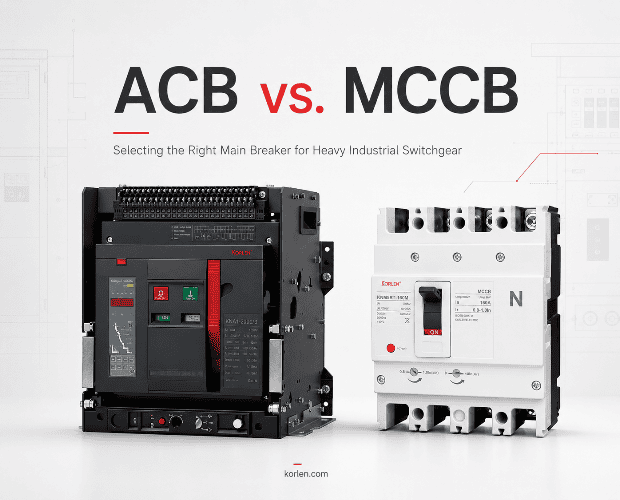
The two devices are complementary, not competitors. They sit at different levels of the same system. The table below summarizes the practical differences a specifier cares about.
| Attribute | Air Circuit Breaker (ACB) | Molded Case Circuit Breaker (MCCB) |
|---|---|---|
| Full name | Air Circuit Breaker | Molded Case Circuit Breaker |
| Typical current range | ~800 A – 6,300 A (main distribution) | Up to 2,500 A (Korlen range) |
| Typical position | Main incoming / bus tie / gen coupling | Feeder / branch / motor / sub-panel |
| Breaking capacity | Very high (system level) | High (feeder level) |
| Short-time withstand (Icw) | High, rated | Lower |
| Protection unit | LSIG, advanced selective | Thermal-magnetic or electronic |
| Installation | Draw-out cradle (often) | Fixed, panel-mounted |
| Physical size | Large | Compact |
| Relative cost | Higher | Lower |
| Best for | Main switchboard, gen coupling, bus tie | Motors, feeders, sub-distribution |
The clearest dividing line is current. While there is overlap (both can cover, say, 800–1,600 A), the application position decides the device:
Rule of thumb: “ACB at the top, MCCB below.” A typical heavy plant reads — ACB (main incomer) → MCCB (feeders) → MCB (final circuits).
A breaker must interrupt the maximum possible fault current at its location. Two ratings matter:
At the main incoming position, prospective fault currents are largest. An ACB is engineered for these system-level duties with higher Icu and a rated Icw. An MCCB offers strong but typically lower ratings suited to feeder and branch positions where fault currents are already partially limited by upstream impedance. Always confirm the breaker’s Icu exceeds the calculated prospective fault current at that point.
Selective coordination means only the device closest to a fault trips, leaving the rest of the plant energized. In a layered system, the main breaker must intentionally delay its trip (via the short-time / ST setting on an LSIG unit) so a downstream MCCB clears the fault first.
| Level | Device | Role |
|---|---|---|
| Incoming | ACB | Main incomer, delayed trip (coordination master) |
| Feeder | MCCB | Clears its own fault first |
| Final circuit | MCB | Terminal protection |
Without an ACB’s adjustable short-time delay at the top, achieving full selectivity in a large plant is difficult. This is why Korlen’s 40-year manufacturing heritage in power distribution emphasizes coordination-ready main breakers.
Use this checklist when specifying the main breaker for a heavy industrial switchboard:
Match your condition to the recommended breaker. (Pure HTML table — no JavaScript, safe for Classic Editor.)
| Your condition | Recommended | Why |
|---|---|---|
| Main incoming, current > ~1,000 A | ACB | High Icu/Icw, coordination master |
| Main incoming, 800–1,000 A, coordination critical | ACB | Future-proof, draw-out maintenance |
| Feeder / motor / sub-panel, ≤ 2,500 A | MCCB | Compact, economical |
| High fault level needs rated Icw | ACB | Short-time withstand rating |
| Space-limited / cost-sensitive branch | MCCB | Small footprint, lower cost |
| Draw-out maintenance required | ACB | Withdrawable cradle design |
1. Forcing an MCCB into a high-fault main position. If its Icu is below the PFC, it cannot safely clear the fault.
2. Oversizing to ACB everywhere. An ACB on a small feeder wastes space and budget.
3. Ignoring coordination settings. Without a delayed ST on the main breaker, a branch fault can drop the whole board.
4. Mixing standards without verification. Confirm IEC 60947-2 (or UL 489) and the assembly standard IEC 61439.
5. Choosing by price alone. Total cost of ownership includes downtime, maintenance, and spare-part strategy.
Korlen manufactures both breaker families under one quality system — so you can build a fully coordinated board from a single, certified supplier. Both lines carry ISO 9001, CB, CE, SEMKO, SIRIM, NF, TSE, SNI, PCT, and RoHS.
Air Circuit Breaker (ACB)
High-capacity main-incoming breaker with LSIG protection and draw-out options for critical switchboards.
Molded Case Circuit Breaker (MCCB)
Compact, adjustable feeders and motor protection up to 2,500 A for downstream duties.
Note: Exact Korlen ACB / MCCB model series (e.g., KAx / KNMx) should be inserted from the product catalog before publishing — the live product pages currently show generic descriptions.
ACB and MCCB differ mainly in application level: an MCCB protects feeders and branch circuits (typically up to 2,500 A), while an ACB serves as the main incoming breaker for high-current distribution with advanced selective coordination. Need the right main breaker? Explore the Korlen Air Circuit Breaker (ACB) range.
There is no single cutoff, but most designers move to an ACB above ~800–1,000 A for the main incoming position, or whenever selective coordination and high short-time withstand are required. Below that, an MCCB is usually sufficient and more economical. Compare options in the Korlen MCCB range.
Yes — an MCCB can serve as a main breaker for smaller panels or sub-distribution up to its rating. But for large main switchboards with high fault levels and coordination needs, an ACB is the safer, standards-aligned choice. See the Korlen Air Circuit Breaker (ACB) for main-incoming duties.
Generally the ACB. ACBs are engineered for higher prospective fault levels and greater short-time withstand (Icw) at the main incoming position. MCCBs offer strong but typically lower breaking capacity suited to feeder and branch duties. Verify ratings on the Korlen Air Circuit Breaker (ACB) product page.
Selective coordination ensures only the faulted circuit trips, leaving the rest of the plant energized. The main breaker (usually an ACB) must delay its trip so downstream MCCBs clear first. Poor coordination causes widespread shutdowns. Learn more from Korlen’s 40-year manufacturing heritage in power distribution.
No. “Better” depends on duty. An ACB is superior for high-current main incoming and coordination; an MCCB wins on compactness, flexibility, and cost for feeders and branches. Using an ACB where an MCCB suffices wastes budget and panel space. Review the Korlen MCCB range for feeder duties.
MCCBs are fixed and panel-mounted — compact, simple to install. ACBs are larger and commonly draw-out (withdrawable) cradle-mounted, enabling safe isolation and maintenance without de-energizing the bus. This makes ACBs ideal for critical main switchboards. Explore the Korlen Air Circuit Breaker (ACB) for draw-out options.
Start with the position: main incoming → ACB; feeder/branch → MCCB. Then check current, fault level, coordination, and maintenance needs. Heavy plants usually need an ACB at the incoming and MCCBs downstream. Get a tailored recommendation from the Korlen MCCB range and ACB team.
Both are covered by IEC 60947-2 (industrial low-voltage breakers) and, in North America, UL 489. They must also meet the assembly standard IEC 61439 for the switchgear they sit in. Korlen products carry CB, CE, SEMKO, SIRIM, NF, TSE, SNI, and more — see the Korlen Air Circuit Breaker (ACB).
Calculate total connected load, apply demand factor, then size for 1.0–1.25× expected maximum current. Confirm the breaker’s Icu exceeds the prospective fault current, and that coordination with downstream devices is verified. Start with the Korlen Air Circuit Breaker (ACB) selection.
Choosing between an ACB and an MCCB is really about deciding where the breaker sits and what it must survive. Put an ACB at the main incoming where current, fault level, and coordination demands are highest; use MCCBs downstream for feeders, motors, and branches. Size by current, fault level, position, and coordination — never by price alone — and your heavy industrial switchgear will be safer, more reliable, and easier to maintain.
Recommended further reading (internal blog links to add after publishing): AC MCB vs DC MCB: A Complete Selection Guide · MCB Trip Curves: Matching Type B, C, D to Inductive Motor Loads · Sourcing Low-Voltage Switchgear from China: The Ultimate Verification Guide.
Specify the Right Main Breaker with Korlen
Whether you need a coordination-ready ACB for the main incoming or compact MCCBs for downstream feeders, Korlen delivers both from one certified quality system.
Need a tailored switchgear bill of materials? Contact the Korlen engineering team.
© 2026 Korlen (GAONENGGELE ELECTRICAL SHARES CO., LTD.). This guide is for general engineering reference; always verify selections against the latest IEC/UL standards and a qualified design review.
GAONENGGELE ELECTRICAL SHARES CO.,LTD.
Privacy Policy | SiteMap
Copyright GAONENGGELE ELECTRICAL SHARES CO.,LTD.