- Whatsapp: +86 15967777035
- Email: [email protected]

In the design and procurement stages of heavy industrial control panels and low-voltage distribution boards, a common sourcing trap frequently misleads junior engineers and B2B purchasing agents: interchanging a standard circuit breaker with a disconnect switch. While both components share a basic similarity on a high-level single-line blueprint—acting as a mechanism to interrupt the flow of electricity—their internal physics, safety compliance profiles, and operational mandates are entirely distinct.
Deploying the incorrect device on a factory floor can trigger catastrophic failure, line damage, and severe safety audits under international frameworks. As an established China Professional Circuit Breaker Manufacturer since 1985, Korlen leverages over four decades of low-voltage electrical heritage to present this definitive engineering guide clarifying when, where, and why you must deploy each component.
To build a reliable power network, procurement teams must grasp how these two devices handle electrical faults and maintenance routines differently.
A circuit breaker is a switch that automatically interrupts excessive electrical currents to defend downstream cables and assets from destruction. It features an internal sensory link composed of bimetallic strips (for long-term thermal overloads) or electromagnetic solenoids (for immediate short-circuit fault mitigation).
When a fault occurs, the breaker trips independently of human intervention. Discover our full low-voltage terminal range on the official Miniature Circuit Breakers (MCB) product line.
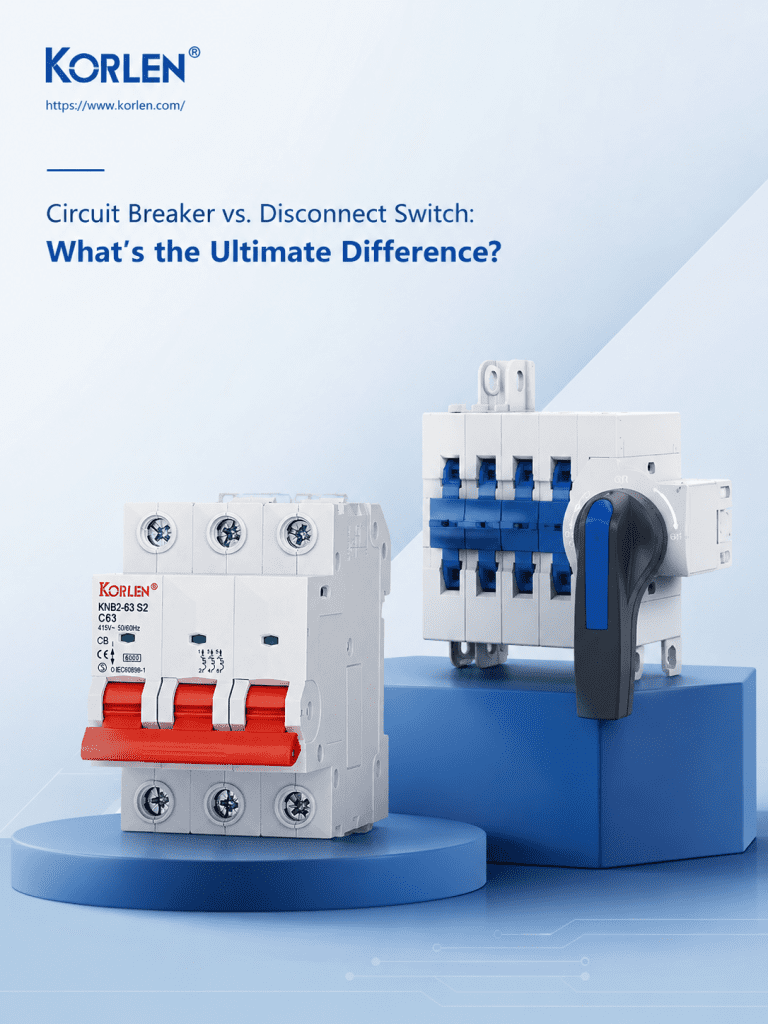
A disconnect switch (often called an electrical isolator or load break switch) is a heavy-duty mechanical safety device operated manually via an external lever or rotary handle. Unlike an automatic breaker, a standard disconnect switch does not possess internal trip sensors. Its singular, vital mandate is to provide a visible, physical air gap in the circuit, ensuring that downstream machinery is completely isolated from the live power grid so field technicians can perform maintenance or troubleshooting with absolute peace of mind.
When cross-referencing suppliers for international electrical bids, looking at generic descriptions is never enough. You must align your BOM (Bill of Materials) with strict international engineering standards:
Understanding the exact physical limitations of a difference between switch and circuit breaker mechanics is critical to avoiding safety liabilities.
When an electrical circuit carrying heavy industrial loads is broken, a violent, superheated plasma arc spans the gap between the separating metal contacts.
A circuit breaker is reactive and automated. If an industrial motor stalls or a cable shorts out, the breaker reacts within milliseconds to eliminate the hazard. A disconnect switch is intentional and manual. It remains closed until a field engineer manually throws the rotary mechanism to enforce a LOTO (Lockout/Tagout) protocol for machine repairs.
Inside a standard industrial control panel, a disconnect switch functions as the primary power gatekeeper, often mounted right at the main enclosure door or incoming feeder line. Circuit breakers branch outward from that main gate, distributed along internal DIN rails or backplates to safe-keep individual sub-circuits, transformers, and automated PLC loops.
For engineering procurement teams and global suppliers mapping out system architectures, utilize this clear reference table to verify component selection:
| Technical Parameter | Industrial Circuit Breaker | Disconnect / Isolation Switch |
|---|---|---|
| Primary Function | Automatic Overcurrent & Short Circuit Defense | Safe Physical Air-Gap Isolation for Maintenance |
| Tripping Mechanism | Automatic (Thermal-Magnetic / Electronic Sensors) | Manual Only (Rotary Handle / Lever Mechanism) |
| Core Regulatory Standard | IEC 60947-2 Compliance | IEC 60947-3 Compliance |
| Arc Chute Integration | Yes, Heavy-Duty Arc Extinguishing Grids Built-in | Minimal or None (Not rated for breaking faults) |
| Lockout/Tagout (LOTO) | Requires special bracket accessories to padlock | Inherent padlocking holes built into the handle |
A highly efficient, code-compliant industrial layout never forces you to choose between these two units—they are designed to work together as a synchronized system.
You deploy a standalone disconnect switch when your circuit path already features adequate upstream overcurrent protection, but local electrical safety codes dictate a mandatory manual cut-off point within visual sight of the machinery (e.g., roof-mounted HVAC compressors or heavy conveyor motors).
For heavy industrial panels, space constraints often prevent the installation of separate massive blocks. The most optimal engineering response is deploying a moulded case circuit breaker with rotary handle disconnect configuration. By mounting a rugged rotary control handle directly through the enclosure door and connecting it to a high-capacity MCCB inner chassis, you achieve the ultimate hybrid layout: premium automatic short-circuit protection and a compliant, highly visible manual entrance disconnect door interlock system combined into a single footprint.
Sourcing your entire array from a trusted complete package electrical switchgear component manufacturer like Korlen streamlines your supply chain. It guarantees perfect mechanical matching between handles, linkages, and inner breaker structures while lowering overall freight overheads and aligning compliance documentation under one roof.
Answer these three engineering questions to instantly verify if your blueprint requires an independent breaker, an isolation switch, or a hybrid configuration:
Only if the disconnect switch is part of a certified fused-combination unit where internal fuses handle the overcurrent clearing duty. A standard non-fused disconnect switch can never replace a circuit breaker because it cannot automatically interrupt fault currents.
Lacking internal arc chutes, opening a manual isolator under a short circuit causes the heavy electrical plasma arc to feed on ambient air, creating an explosive arc flash that can destroy the cabinet and cause catastrophic personal injury.
IEC 60947-2 strictly governs the automatic overcurrent safety performance curves of circuit breakers. IEC 60947-3 dictates the structural isolation parameters, mechanical handle integrity, and physical air-gap dimensions of isolation switches and manual load-break units.
LOTO capacity allows field technicians to mechanically padlock the disconnect switch handle in the “OFF” position. This ensures no other factory worker can accidentally re-energize the heavy machinery while maintenance personnel are working inside the mechanical zones.
Yes. By specifying a molded case circuit breaker with rotary handle disconnect configuration, you combine the high-kA automatic short-circuit clearing capabilities of an industrial MCCB with the visible, mechanical door-interlocked handle isolation of a disconnect switch.
A “Load Break” rating certifies that the isolation switch possesses sufficient engineering reinforcement to safely cut power while the motor or industrial application is actively running at its full nominal current, without destroying the internal contacts.
Not automatically. To serve as a true isolation gate, an MCB or MCCB must be explicitly stamped by the manufacturer with an isolation symbol (a horizontal line with a vertical terminal break) proving its contacts open wide enough to guarantee dielectric safety under high surge voltages.
As a quality-driven manufacturing plant, Korlen utilizes high-purity silver alloy contact points to maintain low contact resistance, paired with high-grade, premium flame-retardant enclosures that withstand extreme thermal stresses without physical degradation.
The kA rating must be determined by a short-circuit study calculating the maximum prospective fault current supplied by your main transformer. The breaker’s ultimate breaking capacity ($I_{cu}$) must exceed this calculated value to avoid structural failure.
Sourcing from a single complete package electrical switchgear component manufacturer ensures flawless physical dimension alignment, unified technical compliance certification (CE, ISO, IEC), and substantial savings on purchasing logistics and bulk component pricing.
Safeguarding heavy machinery assets and establishing compliant factory protocols demands a zero-compromise approach to component distribution. Recognizing the strict functional boundaries between automatic protective circuit breakers and manual physical isolation gates prevents system layout penalties and maximizes operational safety.
Partnering with an experienced, factory-direct industrial low voltage isolation switch supplier and breaker manufacturer optimizes both your project engineering and your corporate bottom line.
Gain direct factory-level bulk pricing, certified IEC compliance documentation, and comprehensive CAD/BIM blueprint file packages for your next low-voltage switchgear project.
GAONENGGELE ELECTRICAL SHARES CO.,LTD.
Privacy Policy | SiteMap
Copyright GAONENGGELE ELECTRICAL SHARES CO.,LTD.