- Whatsapp: +86 15967777035
- Email: [email protected]

China produces over 60% of the world’s low-voltage electrical components. The supply base is vast — from ISO-certified manufacturers with decades of export experience to small workshops with no formal quality system. For international buyers, the gap between these two tiers is not always visible on a website or a product datasheet.
The consequences of choosing the wrong supplier are serious:
| Risk | Impact |
|---|---|
| Unverifiable certifications | Products may not pass local regulatory inspection; project approval delayed or denied |
| No type-test reports | Short-circuit and thermal performance unproven; arc-flash risk to personnel |
| Batch quality variance | Sample looks good, but bulk order has inconsistent tripping thresholds, dimension errors, or material defects |
| No on-site QC lab | Routine tests skipped; each unit is not individually verified before shipping |
According to ABB’s 2025 industrial downtime report, 76% of decision-makers estimate downtime costs at $500,000+ per hour for industrial facilities. Using uncertified or poorly verified MCCB or switchgear assemblies in these environments is a risk no responsible buyer should accept.
Bottom line: Verification is not optional — it is the difference between a successful project and a liability exposure. This guide gives you the framework to make informed sourcing decisions.
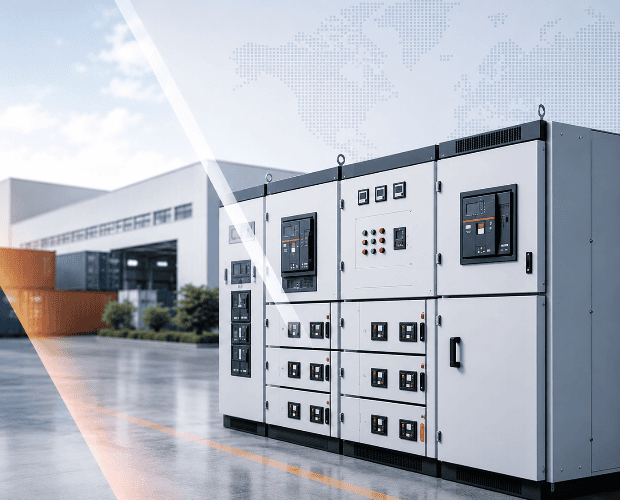
Low-voltage switchgear is a group of electrical devices — MCBs, MCCBs, air circuit breakers (ACBs), isolating switches, contactors, and protection relays — assembled in an enclosure to control, protect, and isolate electrical equipment operating at ≤1,000 V AC or ≤1,500 V DC.
The term “switchgear” can refer to the individual circuit breaker devices, or to the complete assembly (switchboard / panel) that houses them. When sourcing from China, you may be buying either:
The verification requirements differ significantly between these two levels, and this guide covers both.
Before you can verify a supplier, you need to know which standard applies to your product and market. The two dominant frameworks are:
The IEC 61439 series (Edition 3.0) is the global benchmark for low-voltage switchgear and controlgear assemblies. It applies to:
It defines design verification (type tests, Clause 10) and routine verification (factory tests on every unit, Clause 11). Accepted in Europe, Asia, Middle East, South America, and Africa.
UL 1558 covers metal-enclosed low-voltage power circuit breaker switchgear in the United States and Canada. It prescribes:
Complemented by IEEE C37.20.1, ANSI/NETA ATS, and NEC (NFPA 70) for installation and commissioning.
| Dimension | IEC 61439 | UL 1558 |
|---|---|---|
| Geographic scope | Global (EU, Asia, ME, LatAm) | North America (US, Canada) |
| Product scope | LV switchgear & controlgear assemblies | Metal-enclosed LV power circuit breaker switchgear |
| Voltage range | Up to 1,000V AC / 1,500V DC | 254V–1,058V AC / 300V–3,200V DC |
| Max continuous current | Typically up to 4,000A | 1,600A–10,000A AC / up to 12,000A DC |
| Compartmentation | Recommended (form separation per IEC) | Mandatory (bus, breaker, cable compartments) |
| Testing hierarchy | Type test (Clause 10) + Routine verification (Clause 11) | Production tests + Field acceptance tests per NETA |
| Third-party marks | CB, CE, ASTA, DEKRA, TÜV | ETL, UL Listing Mark |
| Korlen alignment | Full compliance — CB, CE, SEMKO, SIRIM, NF | Partners with UL-listed panel builders for NA projects |
Buyer tip: If your project targets Europe, Southeast Asia, the Middle East, or South America, IEC 61439 compliance is your primary benchmark. For North America, UL 1558 / UL 891 applies. Verify that your supplier’s certifications match your actual destination market.
Chinese manufacturers display various certification marks on their websites and product labels. But not all marks carry the same weight. Here is what each mark means, who issues it, and how to verify it:
| Mark | Issuing Body | Scope | How to Verify | Korlen Status |
|---|---|---|---|---|
| CB | IECEE (IEC System) | Global mutual recognition of electrical product testing | Search IECEE CB Certificate Database at cert.iecee.org | Yes |
| CE | EU self-declaration + third-party lab | EU market access (LVD, EMC directives) | EU NANDO Information System (ec.europa.eu/growth/tools-databases/nando) | Yes |
| SEMKO | Intertek / SEMKO | Swedish/European safety mark | Intertek online certificate lookup | Yes |
| SIRIM | SIRIM QAS International (Malaysia) | Malaysian market mandatory for electrical products | SIRIM certificate portal (sirim-qas.com.my) | Yes |
| NF | LCIE Bureau Veritas (France) | French mandatory mark for electrical equipment | LCIE / Bureau Veritas online verification | Yes |
| TSE | Turkish Standards Institution | Turkey market mandatory | TSE certification database | Yes |
| SNI | BSN (Indonesia National Standard) | Indonesia market mandatory | SNI product certification list at BSN portal | Yes |
| PCT | Rosstandart (Russia) | EAC mark for Russia & EAEU customs union | FGIS (Federal Information System) registry | Yes |
| ASTA | Intertek ASTA (UK-based) | High-profile in Asia & Middle East; type-test compliance evidence | Intertek ASTA certificate registry | Partner with ASTA-certified labs |
| ETL | Intertek (North America) | North American product safety listing | Intertek ETL directory | Partner with ETL-listed panel builders |
Warning: Some suppliers display certification logos on websites but cannot produce the actual certificate documents. Always request scanned certificates with visible serial numbers and expiry dates, then cross-check on the issuing body’s official database. A logo on a website is not proof of compliance.
This framework is designed for B2B buyers who need a systematic, repeatable process to evaluate Chinese low-voltage switchgear manufacturers before placing an order.
Identify the specific certification marks required by your destination country’s regulations. Then request the supplier’s actual certificate documents (not just website logos).
Pass criteria: Supplier holds active certificates for every mark required in your destination market, verifiable on the issuing body’s official database.
IEC 61439 Clause 10 requires design verification through type tests — dielectric, temperature-rise, short-circuit, mechanical operation, and more. Ask for the full type-test report, not just a summary.
Pass criteria: Type-test report from an ISO 17025 accredited lab, covering all required test categories, with clear Pass/Fail results and test conditions documented.
Visit the factory or hire a third-party inspection firm to verify: production equipment condition, QC laboratory presence, calibration records, warehouse organization, and employee training systems.
Pass criteria: ISO 9001 QMS in active use, on-site QC lab with calibrated instruments, organized production lines with process traceability.
IEC 61439-1 Clause 11 requires routine verification on every unit before shipment: dielectric test, mechanical operation, wiring check, protective circuit continuity. Ask for the supplier’s routine test procedure and sample test reports.
Pass criteria: Every unit has a documented routine test record with measured values and Pass/Fail determination. Test instruments are calibrated per ISO 17025.
Check that the supplier can meet your order volume within your timeline. Verify: annual production capacity, current order backlog, average lead time, and track record of on-time delivery.
Pass criteria: Demonstrated capacity exceeds your order volume by at least 2×; lead time commitment is documented; references from existing customers confirm delivery reliability.
Before committing to a large order, order a small sample batch. Test it in your own lab or a trusted third-party facility. Check: tripping accuracy, dimension consistency, material quality, insulation resistance, and labeling accuracy.
Pass criteria: Sample test results fall within manufacturer’s declared tolerances. No defects, inconsistencies, or deviations from specification.
For long-term supply partnerships, set up: periodic batch testing, annual factory audits, quality KPI reporting, and a documented escalation process for defects.
Pass criteria: Supplier agrees to ongoing QC protocol, provides quarterly quality reports, and responds to defect notifications within 24–72 hours.
Result: Suppliers who pass all 7 steps have a >90% probability of delivering consistent, compliant products. Suppliers who fail at Steps 1–3 should be eliminated immediately regardless of price advantage.
Use this checklist when evaluating any Chinese LV switchgear manufacturer. Print it and take it to factory audits.
| # | Category | What to Check | Pass Criteria |
|---|---|---|---|
| 1 | Certifications | Active CB, CE, and market-specific marks (SEMKO/SIRIM/NF/TSE) | All required marks present, verified on issuing body databases |
| 2 | Type-Test Reports | IEC 61439 Clause 10 full type-test report from ISO 17025 lab | All test categories covered with documented Pass results |
| 3 | Factory Audit | ISO 9001 QMS, QC lab, calibrated equipment, organized production | ISO 9001 certified, on-site QC lab, instruments calibrated annually |
| 4 | Routine Tests | IEC 61439-1 Clause 11: dielectric, mechanical, wiring, grounding | Test record for every unit; measured values documented |
| 5 | Production Capacity | Annual output, lead time, on-time delivery record | Capacity ≥2× your order volume; lead time documented |
| 6 | Sample Evaluation | Independent test: tripping, dimensions, material, insulation | All results within manufacturer’s declared tolerance |
| 7 | Ongoing QC | Batch testing protocol, quality reports, defect response time | Quarterly reports, 24–72h defect response, agreed QC protocol |
Understanding the three testing tiers is essential for verifying supplier claims. Each tier serves a different purpose and has different requirements:
| Dimension | Type Test (Design Verification) | Routine Test (Every Unit) | Field / Acceptance Test |
|---|---|---|---|
| IEC reference | Clause 10 | Clause 11 | ANSI/NETA ATS / MTS |
| Frequency | Once per design / configuration | Every single unit before shipment | After installation, before commissioning |
| Key test items | Dielectric, temperature-rise, short-circuit, mechanical endurance, IP rating, busbar strength, arc withstand | Dielectric withstand, mechanical operation, wiring/connection check, protective circuit continuity, insulation resistance | Insulation resistance, contact resistance (DLRO), relay calibration, CT/PT verification, breaker trip timing, ground continuity |
| Who performs | ISO 17025 accredited third-party lab | Manufacturer’s QC team (factory) | NETA-certified testing firm or qualified field engineer |
| What buyer should verify | Request full type-test report with lab accreditation evidence | Request sample routine test records; confirm every unit is tested | Specify NETA ATS compliance in purchase contract |
Why this matters for sourcing: A supplier who has type-test reports but skips routine tests on production units is cutting corners. Type tests prove the design is capable; routine tests prove each individual unit meets that standard. Both are mandatory under IEC 61439.
Watch for these warning signs during your evaluation process. Any one of them is reason to pause or eliminate a supplier:
Additional warning signs to watch for:
At Korlen, we believe buyers should verify us the same way we verify our own production. Here is how we pass every step of the 7-Step Framework:
| Step | Korlen Status | Evidence |
|---|---|---|
| 1. Certifications | 9 active certification marks | CB, CE, SEMKO, SIRIM, NF, TSE, SNI, PCT, INMETRO — all verifiable online |
| 2. Type-Test Reports | Available on request | Full IEC 61439 type-test reports from accredited labs for MCB, MCCB, ACB lines |
| 3. Factory Audit | ISO 9001 + ISO 14001 | 38,000 m² facility, on-site QC lab, MCB life-test room, automatic production lines |
| 4. Routine Tests | 100% unit testing | Dielectric, tripping, mechanical operation tested on every unit before shipment |
| 5. Production Capacity | 15M+ MCBs/year | One container in 5 days; 1,000+ employees; 20 expert engineers; 40k pcs/day MCB output |
| 6. Sample Program | Free samples for qualified buyers | Test our MCBs, MCCBs, and ACBs independently before committing to volume |
| 7. Ongoing QC | 24-hour response commitment | Quality reports per batch; defect escalation within 24h; quarterly QC summaries |
At minimum: CB (IEC global mutual recognition) and CE (EU access). For specific markets: SEMKO (Europe), SIRIM (Malaysia), NF (France), TSE (Turkey), SNI (Indonesia), PCT/EAC (Russia). Korlen holds all of these — verify our certifications here.
Request the full type-test report (IEC 61439-1 Clause 10) and verify the lab is ISO 17025 accredited. Check for ASTA or DEKRA certificates as additional evidence. Korlen provides full type-test reports on request — contact our team to request yours.
UL 1558 covers metal-enclosed LV switchgear for North America with mandatory compartmentation and higher short-circuit requirements. IEC 61439 is the global standard for LV assemblies, covering distribution boards, MCCs, and busbar trunking. See the standards comparison table in this article for details.
Yes, for orders above $50,000. An on-site audit lets you verify production lines, QC lab, calibration records, and warehouse organization. Korlen welcomes factory visits — schedule a Korlen factory tour.
IEC 61439-1 Clause 11 mandates: dielectric withstand, mechanical operation, wiring verification, protective circuit continuity, and insulation resistance. Korlen tests every unit — view our MCB products.
Cross-check on the issuing body’s official database: CB → IECEE portal (cert.iecee.org), CE → EU NANDO system, SEMKO → Intertek lookup, SIRIM → SIRIM QAS portal. A website logo is not proof. Request Korlen’s verified certificate documents.
Minimum indicators: ISO 9001 QMS, dedicated QC lab, calibrated equipment, annual MCB capacity above 5 million poles. Korlen produces 15M+ MCB poles/year, 1.5M RCCBs, and 150K MCCBs — see Korlen production data.
Yes, but UL listing requires factory follow-up inspections and is held by few Chinese factories. Korlen focuses on IEC/CB markets and partners with UL-listed panel builders for North American projects. Discuss your NA requirements with Korlen.
The five critical red flags: unverifiable certificates, no type-test reports, sample ≠ batch quality, no on-site QC lab, and vague delivery promises. See the full red flags section in this article for detailed descriptions.
Korlen operates an ISO 9001/14001 certified 38,000 m² facility with an on-site QC lab, tests every unit before shipment, holds 9 international certification marks, offers free samples for qualified B2B buyers, and responds within 24 hours. Request a free sample →
Sourcing low-voltage switchgear from China offers significant cost and scale advantages — but only when backed by rigorous verification. The difference between a successful long-term supply partnership and a costly quality failure comes down to one question: Can the manufacturer prove what they claim?
The 7-Step Verification Framework in this guide gives you a systematic, repeatable process to answer that question before you commit. Use the verification checklist. Cross-check certificates. Request type-test reports. Visit the factory. Test the samples independently.
At Korlen, we welcome this scrutiny — because our 38-year track record, 9 verifiable certification marks, and ISO-certified quality system are designed to give buyers confidence, not just promises.
Korlen passes every step. Request type-test reports, schedule a factory audit, or order free samples.
Published by Korlen Technical Team | July 2026
Korlen Electric — Professional Circuit Breaker Manufacturer Since 1985 | Wenzhou, China
GAONENGGELE ELECTRICAL SHARES CO.,LTD.
Privacy Policy | SiteMap
Copyright GAONENGGELE ELECTRICAL SHARES CO.,LTD.