- Whatsapp: +86 15967777035
- Email: [email protected]

Korlen — Professional Circuit Breaker Manufacturer Since 1985
38,000 m² facility | 1,000+ employees | 50+ patents | 20M+ MCBs per year | Certified: ISO, CB, CE, SEMKO, SIRIM, NF, TSE, SNI, PCT, RoHS
A miniature circuit breaker (MCB) protects a circuit from overload and short circuit by interrupting the current when it exceeds a safe threshold. But “exceeds a safe threshold” is not a simple on/off decision. A motor that draws 8× its rated current for two seconds during startup is not necessarily a fault — it is normal behavior.
This is where the MCB trip curve becomes critical. The curve defines how long the breaker will allow an overcurrent condition before tripping. Choose too sensitive a curve, and the motor will not start because the breaker trips instantly. Choose too tolerant a curve, and the breaker may not protect the cable and motor during a real fault.
For B2B specifiers — panel builders, OEMs, contractors, and system integrators — getting this right means fewer site callbacks, longer equipment life, and safer installations.
Bottom line for buyers: Matching the right MCB trip curve to the motor’s inrush current is the difference between a reliable installation and a service call.
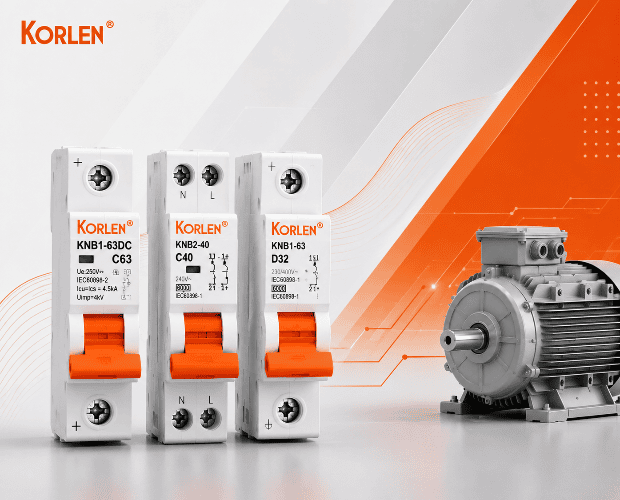
An MCB contains two tripping elements: a thermal element (bimetallic strip) that responds to sustained overload, and a magnetic element (solenoid) that responds to high short-circuit current. The trip curve is a graph that shows how the breaker responds to any current between its rated current and its breaking capacity.
The curve is divided into two zones:
The letter (B, C, or D) tells you the magnetic trip threshold — the point at which the instantaneous magnetic trip activates. This is the primary factor when selecting an MCB for motor loads.
A typical trip curve chart has two axes:
The curve shows a band rather than a single line because manufacturing tolerances, ambient temperature, and initial conditions cause some variation. Anything above the band means “no trip”; anything below the band means “trip.”
Typical Trip Curve Band (IEC 60898-1):
Time to trip
↑
1 h | ······································ Thermal delay band
1 min| ···················
1 s | ·
0.1 s| · Magnetic trip band
─────+──────┬──────┬──────┬──────┬──────────────────────────→ Current
1× 3× 5× 10× 20×
Note: Exact curve shape and thresholds vary by manufacturer and standard. Always consult the datasheet.
The key reading is the magnetic trip multiple. For a Type C MCB, for example, the magnetic trip typically begins at 5× rated current and is guaranteed to trip by 10× rated current. This means a 32A Type C MCB will allow inrush currents up to ~160A to 320A for a short time without nuisance tripping.
The IEC 60898-1 standard defines three common trip curves for household and similar MCBs. Here is how they compare:
| Curve | Magnetic Trip Range | Typical Load | Motor Suitability |
|---|---|---|---|
| Type B MCB | 3× to 5× rated current | Lighting, electronics, resistive heating | Not suitable for most motors |
| Type C MCB | 5× to 10× rated current | Small motors, pumps, HVAC, fluorescent lamps | Best for most motor loads |
| Type D MCB | 10× to 20× rated current | Large motors, transformers, welding machines, compressors | For high-inrush motors |
Rule of thumb: if a motor’s starting current is less than 5× its running current, Type C is usually the right choice. If the starting current is between 10× and 20×, use Type D. If the motor has electronic soft-starters or variable frequency drives (VFDs) that limit inrush, Type C is often still sufficient.
An inductive motor is any load that uses a wound stator to create a magnetic field: induction motors, submersible pumps, fans, compressors, and conveyors. When the motor starts, the rotor is stationary and the winding impedance is low. The current required to establish the magnetic field and begin rotation can be much higher than the normal running current.
This temporary high current is called inrush current or starting current. Typical values:
The inrush current lasts only for a short time — usually a few hundred milliseconds to a few seconds — but it is long enough and high enough to trip an incorrectly chosen MCB.
Example: A 3 kW, 400V three-phase motor may have a full-load current (FLC) of about 5.5A. Its DOL starting current can reach 33A to 55A. A 16A Type B MCB would likely trip during startup. A 16A Type C MCB would ride through the inrush and still protect the circuit during a fault.
Use this checklist to select the right MCB for a motor circuit:
I = P / (√3 × V × cos φ × η) for three-phase motors.Use this reference table to find the recommended MCB trip curve based on your motor load and inrush current. This is a starting point — always verify with a full load study and local code.
| Load Type | Typical Inrush Current | Recommended Curve | Notes |
|---|---|---|---|
| Lighting / resistive loads | 1× to 2× FLC | Type B | High sensitivity; fast protection |
| Small motors, pumps, fans (≤5 kW) | 5× to 8× FLC | Type C | Most common motor choice |
| Medium motors (5–15 kW) | 6× to 10× FLC | Type C or D | Use D if DOL start and high inertia |
| Large motors, compressors | 10× to 15× FLC | Type D | High inrush tolerance |
| Transformers, welders | 10× to 20× FLC | Type D | Very high inrush |
| VFD / soft-starter motors | 1.5× to 3× FLC | Type C | Inrush is limited by drive |
Type B trips at 3–5× rated current. Most motor inrush exceeds this, leading to nuisance tripping every time the motor starts.
A larger MCB may not protect the motor cable during overload. Always match the MCB to the cable’s current-carrying capacity, not just the motor.
DOL starting produces much higher inrush than star-delta or VFD. A motor that works with Type C on a VFD may need Type D on DOL.
If the prospective short-circuit current at the panel exceeds the MCB’s Icn, the breaker may fail to clear a fault safely.
Korlen has manufactured miniature circuit breakers for over 40 years. Our MCB range covers the three standard trip curves and is designed for global motor-protection applications.
| Parameter | Korlen MCB Specification |
|---|---|
| Standards | IEC 60898-1, IEC 60947-2 |
| Trip curves | Type B, Type C, Type D |
| Rated current | 6A – 63A (standard); custom ratings available |
| Breaking capacity | 4.5kA / 6kA / 10kA |
| Poles | 1P, 1P+N, 2P, 3P, 3P+N, 4P |
| Certifications | ISO9001, CB, CE, SEMKO, SIRIM, NF, TSE, SNI, PCT, RoHS |
| Annual capacity | 20+ million MCBs |
| Warranty | 3 years |
For large motor-protection projects, contact our engineering team for application support and custom specification.
An MCB trip curve is a graph showing the relationship between overcurrent magnitude and the time it takes for the breaker to trip. It is determined by the thermal and magnetic trip elements inside the MCB. The curve type (B, C, or D) tells you the magnetic-trip sensitivity, which is the key factor for motor-load selection.
Type B trips at 3–5× rated current, Type C at 5–10×, and Type D at 10–20×. Type B is for sensitive loads like lighting and electronics. Type C is the standard for small to medium motors. Type D is for large motors, transformers, and high-inrush equipment.
For most inductive motor loads, Type C is the best choice because it tolerates typical motor inrush currents of 5–10× rated current. For large motors with DOL starting or high inertia, Type D is the better choice. Only very small motors with minimal inrush can use Type B.
Motor inrush current is the temporary surge of current drawn when a motor starts, typically 5–12× the normal running current. It matters because the MCB must allow this surge without nuisance tripping while still protecting against real overloads and short circuits.
Generally, no. Type B MCBs trip at 3–5× rated current, which is too sensitive for most motor inrush currents. The result is usually nuisance tripping every time the motor starts. Only use Type B for very small motors where the inrush is confirmed to be below 5× rated current.
If the curve is too sensitive, the breaker will trip every time the motor starts, causing downtime and equipment wear. If the curve is too tolerant, the MCB may not trip during an overload, risking cable damage, motor burnout, or fire.
The horizontal axis shows current as a multiple of the MCB’s rated current (In). The vertical axis shows time to trip. The thermal portion handles low overcurrents with a delay; the magnetic portion handles high fault currents instantly. Anything below the curve band means the breaker will trip; anything above means it will not.
IEC 60898-1 uses the B/C/D letter curves and is common in Europe, Asia, and most of the world. UL 489 uses similar concepts but has different test protocols and may use different naming. Always verify which standard applies to your project and market.
The breaking capacity (Icn) must be equal to or greater than the prospective short-circuit current at the point where the MCB is installed. For most commercial and industrial motor circuits, 6kA or 10kA is sufficient, but always calculate the PSC for your specific installation.
Korlen offers free samples for qualified bulk orders and typically responds to inquiries within 24 hours. Share your motor rating, voltage, starting method, and required quantity, and our team will recommend the correct MCB curve and rating.
Matching the right MCB trip curve to an inductive motor load is not guesswork — it is a simple, rules-based process. Start with the motor full-load current, estimate the starting current, choose the curve that rides through the inrush, and verify the breaking capacity and cable protection.
For most motor applications, Type C is the right choice. For high-inrush motors using direct-on-line starting, Type D provides the tolerance needed. Type B should rarely be used on motor circuits.
When you need a reliable supply of Type B, C, and D MCBs for global markets, Korlen MCBs offer the certifications, capacity, and customization support that B2B buyers expect.
Korlen’s engineering team can help you specify the correct Type B, C, or D MCB for any motor application — from small pumps to large industrial drives.
KORLEN — Professional Circuit Breaker Manufacturer Since 1985
www.korlen.com | ISO9001 | CB | CE | SEMKO | SIRIM | NF | TSE | SNI | PCT | RoHS
This article is for informational purposes only. Always consult qualified electrical professionals for project-specific specifications.
GAONENGGELE ELECTRICAL SHARES CO.,LTD.
Privacy Policy | SiteMap
Copyright GAONENGGELE ELECTRICAL SHARES CO.,LTD.