- Whatsapp: +86 15967777035
- Email: [email protected]

Choosing between a modular contactor and an industrial AC contactor decides how efficiently your distribution board switches lighting, HVAC and smart-building loads. This guide compares both technologies, the standards that apply, and exactly when to specify each for DIN-rail and panel-mounted control.
Modern commercial and residential buildings are no longer simple switchboards. Lighting schedules, daylight harvesting, HVAC staging, EV charging and renewable integration all rely on frequent, reliable load switching from a compact DIN-rail footprint. Specifying the wrong contactor type creates two failure modes:
The right device matches the load type, switching frequency, current and mounting method of the installation. For specifiers, that starts with understanding what each contactor actually is.
A modular contactor is a DIN-rail-mounted switching device built in the same form factor as a miniature circuit breaker. It clips onto a 35 mm rail inside a distribution board and is optimized for resistive and light inductive loads — lighting, heating, ventilation, pumps and small appliances. Modular contactors typically follow IEC/EN 61095 (the standard written specifically for them) and are rated using the AC-7a / AC-7b utilization categories. They are compact, hum-free and designed for high switching frequency in occupied buildings.
An industrial AC contactor (often built on the IEC 60947-4-1 frame, e.g. the classic “CJX / LC” style) is a larger, panel- or rail-mountable device engineered for heavy inductive motor loads. It is rated for high inrush current, frequent or severe duty, and harsh electrical environments, using the AC-3 utilization category for motor starting. These contactors commonly pair with overload relays to form motor starters and dominate factory, pump and compressor applications.
| Attribute | Modular Contactor | Industrial AC Contactor |
|---|---|---|
| Primary load | Resistive / light inductive (lighting, heating, fans) | Inductive motor loads (pumps, compressors, conveyors) |
| Mounting | 35 mm DIN rail, snap-on, breaker-style | DIN rail or panel/screw, larger frame |
| Typical current | Up to ~63 A (AC-7a) | Up to several hundred A (AC-3) |
| Footprint | 1–4 modules wide, space-saving | Bulky, needs more panel space |
| Switching frequency | High — daily on/off, dimming, sensors | Lower — motor start/stop cycles |
| Noise | Hum-free, suitable for occupied rooms | Audible hum under load |
| Coil voltage | 24 / 110 / 230 V AC (low-voltage control) | 24 / 110 / 220 / 380 V AC/DC |
| Key standards | IEC/EN 61095, IEC 60947-4-1 (AC-7) | IEC 60947-4-1 (AC-3) |
| Relative cost | Lower for the rating | Higher, but sized for duty |
Neither is “better” universally. The correct choice follows the load profile and mounting environment of the project.
Two standards families tell you what a contactor is really rated for:
The utilization category defines the duty:
| Category | Typical use | Common in |
|---|---|---|
| AC-7a | Resistive loads (lighting) | Modular contactors |
| AC-7b | Slightly inductive (small motors, fans) | Modular contactors |
| AC-3 | Motor starting, running and stopping | Industrial AC contactors |
Always match the category to the load: a lighting circuit belongs in AC-7a, a pump motor in AC-3. Mixing them is the most common specification error.
Choose a modular contactor when: the load is resistive or lightly inductive (lighting, heating, ventilation, smart-home switching), the current is ≤ ~63 A, mounting must be on a 35 mm DIN rail inside a distribution board, and the device sits in an occupied space where silence matters.
Choose an industrial AC contactor when: the load is a motor or other heavy inductive equipment, inrush current is high, the rating exceeds ~100 A, the duty is severe, or the contactor must pair with an overload relay in a motor-starter assembly.
For many buildings the answer is both: modular contactors on the lighting and HVAC-control branches, industrial AC contactors on the pump and compressor feeders — sourced from one supplier for coordinated documentation.
Korlen manufactures the KNHC modular contactor specifically for building automation and lighting control. Engineered for 35 mm DIN-rail installation, it switches household and similar loads — lighting, heating, ventilation and pumps — with a compact, hum-free electromagnetic system suited to residential smart homes, hotels and commercial buildings.
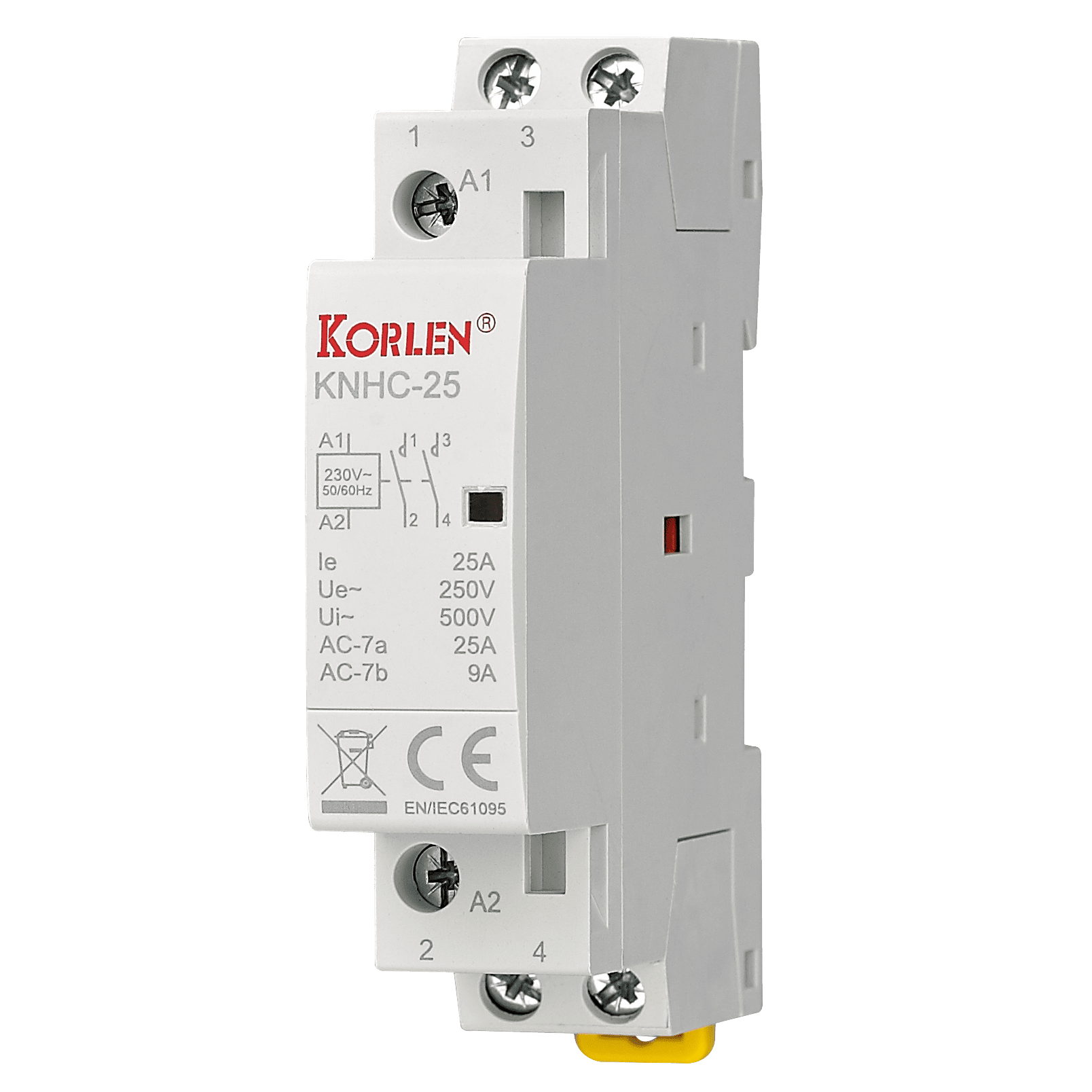
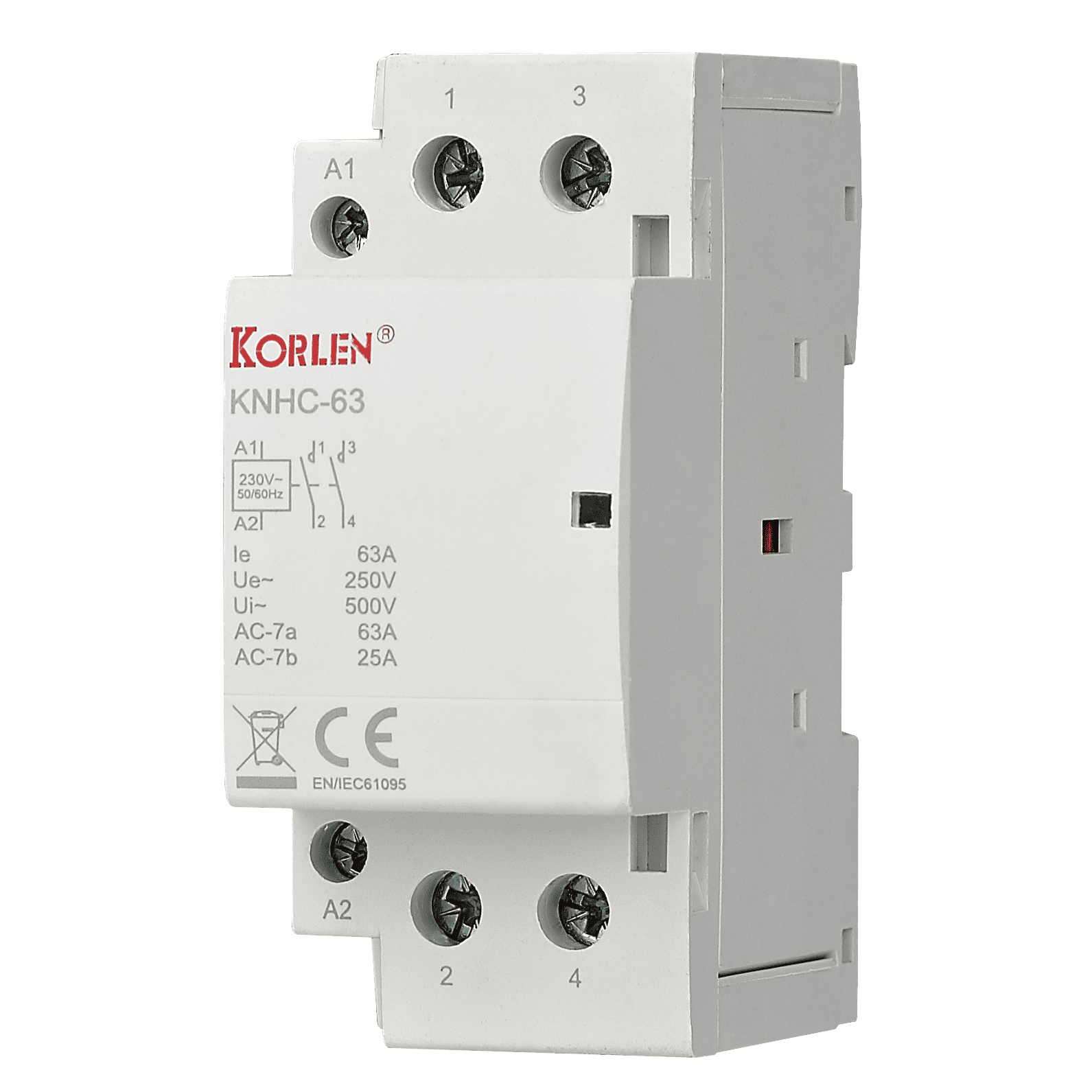
Korlen KNHC modular contactor — click either image for full specifications.
Key specifications:
For industrial AC contactor requirements, Korlen’s AC contactor and industrial component range covers heavier motor-duty frames alongside the KNHC modular line — letting panel builders source both from one manufacturer.
Use this sequence on your next specification:
No, not for motor duty. A modular contactor is rated for resistive and lightly inductive loads (AC-7a/AC-7b), while an industrial AC contactor handles high-inrush motor starting (AC-3). Using a modular unit on a motor will cause contact welding and early failure. For motor loads, see Korlen’s industrial AC contactor range.
Modular contactors are typically rated up to about 63 A in the AC-7a (resistive) category, with AC-7b (lightly inductive) ratings in the 6–25 A range. Above that, an industrial AC contactor is the correct choice.
Very close. A lighting contactor is a modular contactor optimized for resistive lamp loads and high switching frequency. The Korlen KNHC modular contactor is exactly this device — built for DIN-rail lighting and building control.
No. Its compact, breaker-style housing clips directly onto a 35 mm DIN rail inside the distribution board, occupying just 1–4 modules. That is the main space advantage over bulkier industrial frames.
Modular contactors are covered by IEC/EN 61095 and also comply with IEC 60947-4-1. Korlen KNHC units meet both, under ISO 9001 quality control.
Yes — properly designed modular contactors are hum-free, which is why they are specified for hotels, hospitals, offices and homes where an audible hum would be unacceptable. Korlen KNHC emphasizes low-noise operation.
Only for very small pumps within the AC-7b rating. A standard circulation or booster pump is an inductive motor load and should use an industrial AC contactor (AC-3) with a thermal overload relay.
For modular contactors, common control coils are 24 V, 110 V and 230/240 V AC, matching BMS and low-voltage control supplies. Korlen KNHC offers 24/110/240 V AC options.
Yes. Because they switch on a low-voltage control signal, modular contactors integrate cleanly with timers, occupancy sensors, PLCs and building-management systems for scheduled and automated load control.
Send Korlen your load type, current, coil voltage and mounting requirement. The engineering team can recommend the correct KNHC modular or industrial AC contactor and provide specifications and OEM/ODM pricing.
Korlen’s engineering team can match your DIN-rail or panel-mounted control scheme to the correct modular or industrial AC contactor.
GAONENGGELE ELECTRICAL SHARES CO.,LTD.
Privacy Policy | SiteMap
Copyright GAONENGGELE ELECTRICAL SHARES CO.,LTD.