- Whatsapp: +86 15967777035
- Email: [email protected]

In industrial and residential electrical systems, most people are familiar with the MCB (Miniature Circuit Breaker). However, an MCB is designed to protect cables and equipment from overloads—it is often too slow to save a human life from a minor leakage.
This is where the Residual Current Circuit Breaker (RCCB) becomes essential. As a specialized safety device, the RCCB detects minute leakages to the ground, disconnecting power in milliseconds to prevent fatal electric shocks and electrical fires.
The core logic of an RCCB is simple yet brilliant: Current In must equal Current Out.
In a healthy and properly designed electrical circuit, the current flowing through the Phase (Live) wire is exactly balanced by the current returning through the Neutral wire. This stable current balance is essential for the safe operation of distribution systems, including MCCB molded case circuit breaker protected circuits and general power distribution networks.
If a fault occurs — such as insulation failure, equipment short circuit, or a person touching an exposed live conductor — some current “leaks” to the ground instead of returning via the neutral path. This leakage not only creates an unsafe residual current but can also impose abnormal stress on downstream protective devices like MCCB circuit breakers for industrial power distribution.
The RCCB’s internal sensing transformer continuously monitors for this current imbalance. If the difference reaches a dangerous threshold (e.g., 30mA), the device trips instantly to cut off power. This rapid response works alongside MCCB molded case circuit breakers for overload and short circuit protection, forming a comprehensive safety system that guards against electric shock, fire hazards, and damage to wiring and connected electrical equipment.
To provide the best advice to your clients, it is important to understand that these two devices serve different purposes:
| Feature | MCB (Miniature Circuit Breaker) | RCCB (Residual Current Circuit Breaker) |
| Protects | Wires & Equipment | Human Beings |
| Detects | Short Circuits & Overloads | Earth Leakage Current |
| Trigger | High Current (e.g., 20A, 63A) | Tiny Imbalance (e.g., 30mA) |
| Mandatory Use | Every Circuit | Wet areas, sockets, and human-contact points |
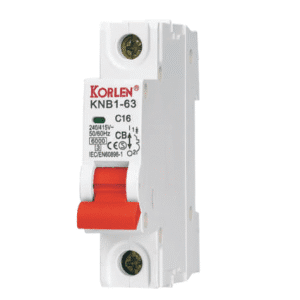
| MCB
|
RCCB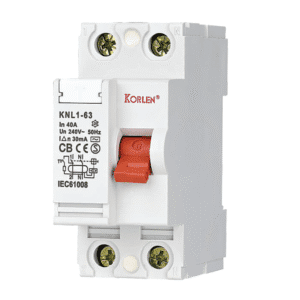 |
In short, MCBs defend your system against overload and short circuits, while RCCBs guard people against electric shock.For a complete and safe power distribution solution, they are often used together rather than as alternatives.This combination is widely applied in residential, commercial and industrial projects, making it essential for wholesalers to offer both for full client protection.
One of the most frequent questions in B2B procurement is choosing the right sensitivity level.
30mA Sensitivity (Human Life Protection): This is the standard for residential homes and offices. It trips at a level low enough to prevent cardiac arrest in humans.
100mA / 300mA Sensitivity (Fire Protection): In industrial environments, large machines naturally have small, harmless “leakages.” A 30mA RCCB would trip too often (nuisance tripping). Therefore, 300mA models are used to detect larger faults that could cause sparks and electrical fires.
Upstream ConfigurationInstall 100mA/300mA RCCBs at the main incoming side, working with MCCBs for power distribution to achieve overall leakage and fire protection, ensuring stable operation of production equipment.
Downstream ConfigurationEquip branch circuits with 30mA RCCBs and small MCBs for personal protection. This graded design matches MCCB industrial circuit breakers to balance safety, reliability and uninterrupted power supply.
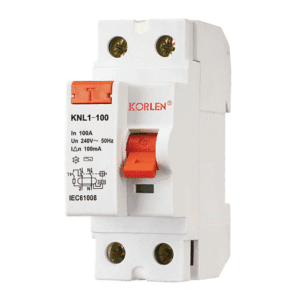
At Korlen, we specialize in high-precision leakage protection. Our KNL1 Series RCCB is a top choice for global distributors due to:
Dual-Pole & Four-Pole Options: Available in 2P (Single Phase) and 4P (Three Phase) configurations to suit any infrastructure.
Certified Reliability: Fully compliant with IEC/EN 61008-1 standards, ensuring acceptance in international markets.
Visual Safety Indicators: Features a clear “Test” (T) button to allow users to verify the internal mechanism regularly.
Durable Design: Built with high-quality flame-retardant materials to withstand harsh industrial conditions.
Q1: What is the main function of an RCCB? The primary function of an RCCB is to protect human life by detecting earth leakage and disconnecting the power instantly.
Q2: Can an RCCB replace an MCB in a circuit? No, an RCCB cannot replace an MCB because it does not protect against overloads or short circuits.
Q3: What is the difference between 30mA and 300mA sensitivity? A 30mA RCCB is designed for human life protection, while 300mA models are used for industrial fire prevention.
Q4: How often should I press the “Test” button on my Korlen RCCB? We recommend pressing the “Test” button once a month to ensure the internal tripping mechanism is functioning correctly.
Understanding the RCCB is vital for ensuring comprehensive electrical safety. While the MCB acts as a shield for your hardware, the RCCB is the ultimate guardian of human life. For a truly “fail-safe” system, combining both is the industry standard. Ate Korlen, we provide the precision-engineered components you need to build trust and safety into every project.
Upgrade your safety standards today—Explore Korlen’s Premium RCCB Collections and ensure your power systems are fully protected!
GAONENGGELE ELECTRICAL SHARES CO.,LTD.
Privacy Policy | SiteMap
Copyright GAONENGGELE ELECTRICAL SHARES CO.,LTD.