- Whatsapp: +86 15967777035
- Email: [email protected]

In modern industrial power distribution and grid infrastructure, system reliability is the thin line between seamless factory automation and catastrophic downtime. At the heart of this infrastructure is a switch that automatically interrupts dangerous electrical abnormalities before they destroy capital equipment or compromise human safety.
However, for electrical engineers, panel builders, and B2B procurement managers sourcing components for global projects, selecting the right protective gear can be daunting. From residential DIN-rail modules to heavy-duty industrial switchgear, one size never fits all.
As an established China Professional Circuit Breaker Manufacturer, Korlen leverages over four decades of engineering excellence to deliver this definitive technical guide on understanding different circuit breaker types to streamline your next project’s Bill of Materials (BOM).
The first matrix used by global power system engineers to classify automatic switches is the operational voltage threshold. Matching the structural insulation of the device to the grid network prevents arc-flash hazards and explosive dielectric breakdowns.
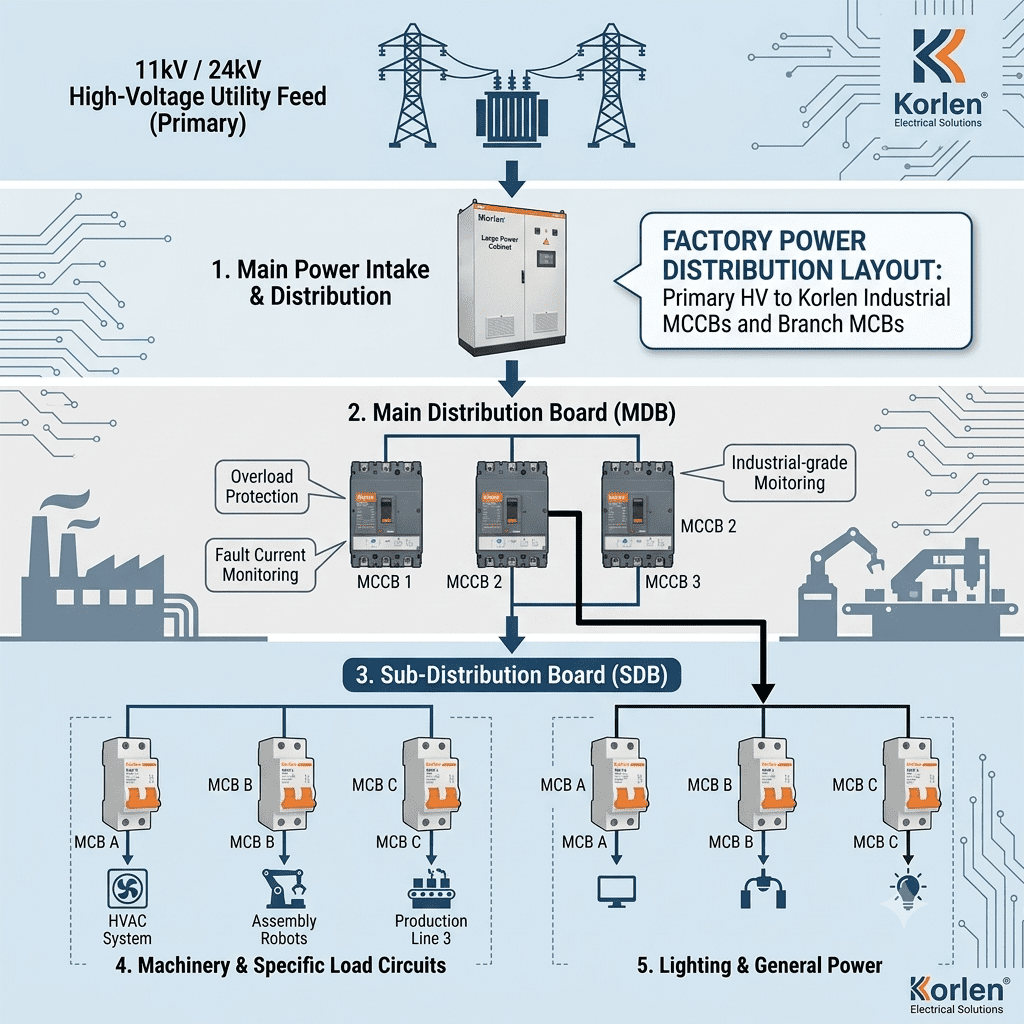
This is the most active product tier in industrial control cabinets, commercial real estate distribution networks, and OEM machinery. Low-voltage devices are engineered for rapid installation, modular space-saving designs, and standard terminal safety.
Miniature Circuit Breakers (MCB): Engineered primarily for branch circuits and terminal load protection. Discover our full engineering specifications on the official Miniature Circuit Breakers (MCB) product category line.
Moulded Case Circuit Breakers (MCCB): Housed in heavy-duty, flame-retardant molded cases to handle high current capacities and main line defense. View advanced technical parameters on our dedicated Moulded Case Circuit Breaker (MCCB) manufacturing page.
These industrial beasts transition away from standard plastic enclosures to robust metal-clad structures. They are deployed in primary utility substations, heavy mining operations, and regional transmission grids to interrupt massive fault currents without compromising the surrounding municipal grid.
Whenever a high-power circuit is severed under load, a destructive electrical arc (plasma) spans the separating contacts. How a device quenches this intense thermal plasma determines its footprint, life expectancy, and specific industry fit.
Air circuit breakers utilize ambient atmospheric air pressure to stretch and cool the electrical arc within specialized arc chutes. They are highly favored as the main incoming breakers in low-voltage main distribution boards (MDBs).
Vacuum circuit breakers enclose the electrical contacts within an ultra-pure, hermetically sealed vacuum interrupter chamber. Because a vacuum lacks gas molecules to ionize, the arc is extinguished almost instantly upon separation. This makes VCB technology the gold standard for high-cycle medium-voltage industrial installations.
Sulfur Hexafluoride ($SF_6$) gas exhibits exceptional dielectric strength and thermal conductivity. $SF_6$ circuit breakers are extremely compact and highly reliable for high-voltage outdoor substations, though they require strict environmental monitoring.
Modern electrical design demands a blend of robust thermal-magnetic physics and smart digital capabilities. Furthermore, infrastructure defense must seamlessly interface with life-safety protocols.
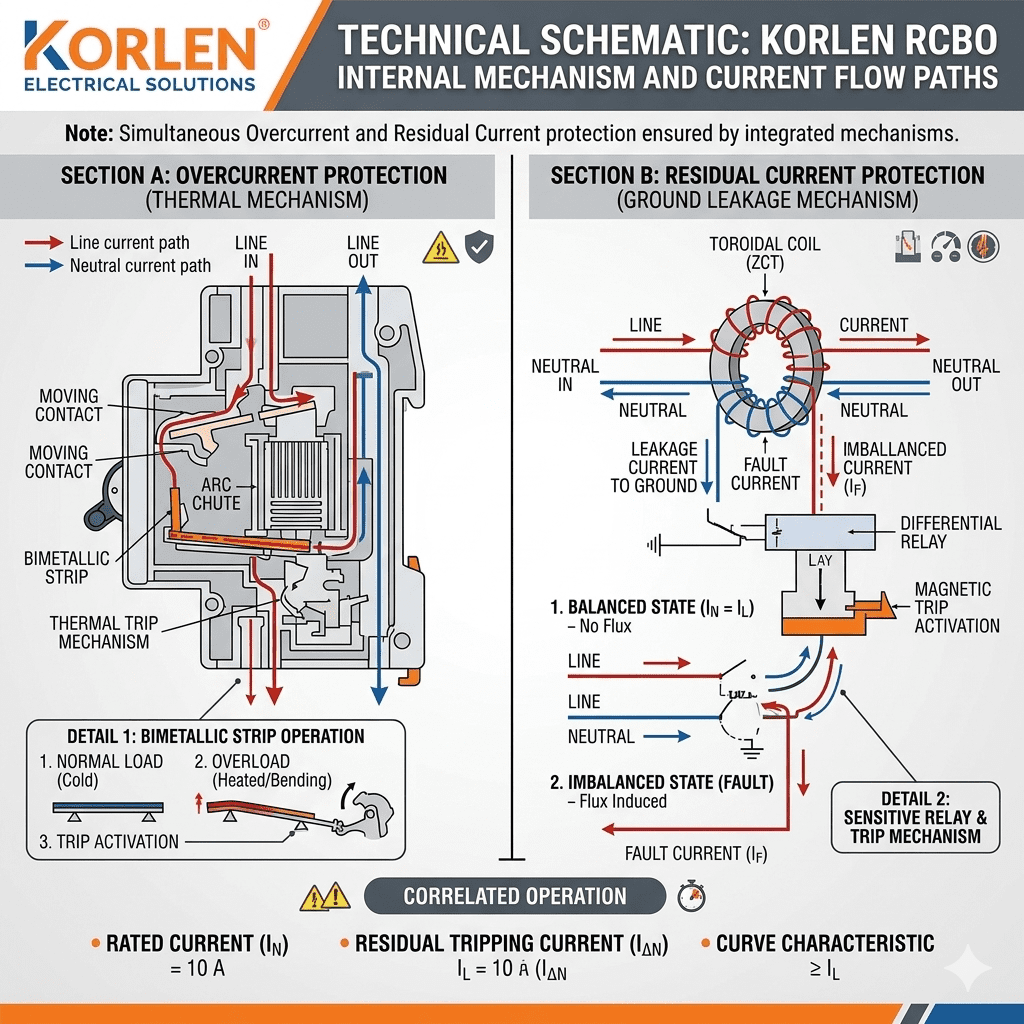
Traditional industrial switches utilize a bimetallic strip for slow, long-term overload defense paired with a magnetic solenoid for immediate short-circuit interruption. Modern premium networks, however, opt for microprocessor-based electronic trip units, allowing procurement managers to fine-tune exact time-delay settings to prevent nuisance tripping caused by high inductive loads.
While standard overcurrent breakers protect copper cabling and heavy machinery from burning up, they are completely blind to low-level ground faults that can kill an operator.
Pure Leakage Defense: To track hazardous residual currents escaping to the earth, systems integrate a dedicated Residual Current Circuit Breaker (RCCB) that cuts off power within milliseconds of structural leakage detection.
The Integrated 3-in-1 Powerhouse: For modern compact layouts, engineers specify an all-in-one RCBO breaker solution that unifies overload, short circuit, and life-saving earth fault mitigation into a single physical unit.
For global suppliers compiling technical specifications for corporate procurement biddings, ensure your selected types of circuit breakers in power system setups match this strict parameter matrix:
| Technical Parameter | Engineering Designation | Direct Sourcing Impact |
| Rated Voltage ($U_n$) | Max Continuous Grid Voltage | Prevents insulation breakdown across terminals |
| Rated Current ($I_n$) | Maximum Continuous Load (Amps) | Dictates frame sizing (e.g., MCB up to 125A vs MCCB up to 1600A) |
| Interrupting Capacity ($I_{cu}$) | Ultimate Short-Circuit Breaking (kA) | Ensures the device can safely kill a fault without exploding |
| Trip Curves | Type B, C, D, or Adjustable Electronic | Matches the breaker to resistive, inductive, or high-inrush motor loads |
| Compliance Certifications | CE, IEC 60947-2, ISO9001 | Unlocks regulatory approval for European, Middle Eastern, and Asian bids |
An MCB (Miniature Circuit Breaker) is engineered for lower current loops (typically up to 125A) with fixed trip characteristics for DIN-rail mounting. An MCCB (Molded Case Circuit Breaker) handles high currents (up to 1600A+), features adjustable trip profiles, and is built to withstand massive short-circuit breaking loads in industrial settings.
VCBs use a sealed vacuum container which has vastly superior dielectric recovery compared to ambient air. This allows VCBs to quench arcs faster, operate within a much smaller physical footprint, and deliver a completely maintenance-free contact lifecycle.
No. A pure RCCB (Residual Current Circuit Breaker) only monitors current balance to detect earth leakage faults. It does not possess thermal-magnetic elements to interrupt short circuits or overloads. It must always be paired with an upstream MCB or replaced entirely with an integrated RCBO.
The breaking capacity (e.g., 10kA, 36kA, 50kA) indicates the maximum fault current that the automatic switch can safely interrupt without experiencing catastrophic structural or terminal destruction.
Standard thermal-magnetic units rely on bimetallic heat accumulation to trip during overloads. In high-temperature zones (such as industrial desert complexes or unventilated control cabinets), breakers must be derated according to the manufacturer’s technical temperature correction charts to avoid premature tripping.
Type B: Trips at 3-5 times rated current; ideal for purely resistive loads like domestic lighting and electric heaters.
Type C: Trips at 5-10 times rated current; the global standard for inductive commercial loads, fans, and fluorescent arrays.
Type D: Trips at 10-20 times rated current; critical for protecting heavy industrial transformers, motors, and high-inrush machinery.
Electronic trip units utilize internal current transformers (CTs) and digital microprocessors to sample current waves. They provide extreme accuracy, are immune to ambient room temperature fluctuations, and allow custom setting of long-time, short-time, and instantaneous trip parameters.
For global B2B projects outside North America, low-voltage components must comply with IEC 60947-2 for industrial distribution or IEC 60898-1 for residential applications, validated by recognized safety markings such as the CE certificate.
$SF_6$ gas possesses electronegative properties that allow it to absorb free electrons rapidly, quenching high-voltage arcs up to 10 times faster than air. It enables the construction of ultra-compact Gas Insulated Switchgear (GIS) for crowded urban substations.
With over 40 years of factory experience, Korlen implements fully automated precision assembly lines, premium silver alloy contact configurations, and 100% rigorous multi-stage end-of-line electrical testing certified to ISO9001 and CE frameworks.
Understanding different circuit breaker types is the ultimate cornerstone of building safe, efficient, and cost-effective industrial infrastructure. By matching the precise voltage constraints, arc-quenching media, and safety protection loops to your specific environment, you safeguard million-dollar industrial assets and protect human lives.
As a premier low-voltage component manufacturer, Korlen provides a complete ecosystem of rigorously tested protection hardware tailored to meet the exacting standards of global B2B procurement.
Secure your power distribution boards with field-tested engineering excellence. Contact Us today to speak with our application engineers, request custom wholesale quotes, or download comprehensive CAD/BIM product blueprints!
GAONENGGELE ELECTRICAL SHARES CO.,LTD.
Privacy Policy | SiteMap
Copyright GAONENGGELE ELECTRICAL SHARES CO.,LTD.