- Whatsapp: +86 15967777035
- Email: [email protected]

Navigating the world of electrical protection can often feel like deciphering an “alphabet soup” of acronyms. From MCB and MCCB to RCCB and RCBO, each device serves a distinct purpose in safeguarding lives and equipment from electrical hazards. Choosing the wrong device isn’t just a technical error; it can lead to catastrophic system failures or safety risks.
As a China Professional Circuit Breaker Manufacturer Since 1985, Korlen has spent over 40 years engineering high-performance solutions for global markets. Our legacy is built on helping electrical contractors, wholesalers, and engineers understand that the right protection strategy starts with knowing exactly what each “alphabet” in the code stands for.
The most common threat to any electrical system is overcurrent—either through a steady overload or a sudden short circuit. While both MCB and MCCB are designed to handle these issues, they operate in very different “weight classes”.
The Miniature Circuit Breaker (MCB) is the workhorse of residential and light commercial applications. Its primary role is to protect branch circuits from damage caused by excess current.
Current Range: Typically rated up to 125A.
Breaking Capacity: Usually handles up to 10kA.
Application: Ideal for lighting circuits, home appliances, and small office equipment.
Key Feature: They are modular and designed for easy installation on standard DIN rails.
When the power requirements scale up to industrial levels, the Moulded Case Circuit Breaker (MCCB) takes over.
Current Range: Ratings can extend from 10A all the way to 1600A or higher.
Breaking Capacity: Designed to interrupt much larger fault currents, often exceeding 100kA.
Adjustability: Unlike most MCBs, many MCCBs feature adjustable trip settings, allowing engineers to fine-tune the protection based on specific motor loads or industrial machinery.
Application: Used in main distribution boards, heavy industrial plants, and large-scale commercial complexes.
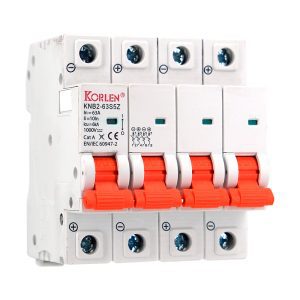
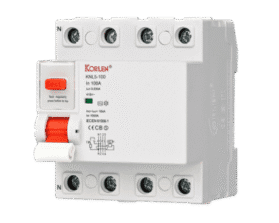
Overcurrent protection saves your wires from melting, but it doesn’t necessarily save a person from a lethal shock. For that, you need devices that monitor “residual current” or leakage.
The Residual Current Circuit Breaker (RCCB), also known as an RCD (Residual Current Device), is a life-saving tool. It constantly monitors the balance between the live and neutral wires. If current leaks to the ground (earth)—for example, through a person touching a faulty wire—the RCCB trips instantly.
Constraint: An RCCB does not protect against overloads or short circuits. It must always be paired with an MCB or a fuse to be part of a complete protection system.
The RCBO breaker is the “all-in-one” evolution of circuit protection. It combines the functions of an MCB and an RCCB into a single modular unit.
Triple Protection: It guards against overloads, short circuits, and earth leakage.
Space Saver: Because it replaces two devices, it is the preferred choice for compact distribution boards.
Independent Safety: In a board with multiple RCBOs, a fault on one circuit only trips that specific rcbo circuit breaker, leaving the rest of the building in the dark.
[IMAGE INSERTION POINT 2]: An internal diagram or high-resolution close-up of a Korlen RCBO, pointing out the “Test” button and the current rating markings.
Selecting the right device involves more than just matching numbers. You must consider the environment and the types of loads being used.
When you examine a Korlen RCBO, you will notice specific symbols that indicate its “Type.” These are critical for compliance:
Type AC: For standard residential AC loads (lights, heaters).
Type A: Required for circuits with electronic components (computers, LED drivers) that may produce pulsating DC currents.
Type B: Used in specialized industrial environments like EV charging stations or high-frequency inverters.
Residential: Typically uses a mix of MCB units for general lighting and RCBO breaker units for wet areas like kitchens and bathrooms.
Commercial: Often utilizes a main MCCB for the building entry, feeding into various rcbo circuit breaker panels for floor-level protection.
Industrial: Heavily relies on MCCB for motor control and heavy machinery, alongside residual circuit current breakers for large-scale earth fault protection.
Even the best residual current operated circuit breaker will fail if not installed correctly. Professional wiring is the backbone of electrical safety.
Correctly wiring a rcbo is different from wiring a standard MCB.
Dedicated Neutrals: Each RCBO must have its own neutral connection directly from the neutral bar. If neutrals are shared between different rcbo circuit breaker units, they will suffer from “nuisance tripping”.
Correct Torque: Ensure terminals are tightened to the manufacturer’s specified torque to prevent overheating and arc flashes.
For maximum safety, your protection devices should be installed downstream of a high-quality AC Isolator Switch. This allows for the entire panel to be de-energized for maintenance without disturbing the settings of the individual breaker rcbo units.
[IMAGE INSERTION POINT 3]: A wiring topology diagram showing the flow from an Isolator Switch to an MCB and an RCBO in a standard distribution board.
As a leading China Professional Circuit Breaker Manufacturer, Korlen doesn’t just assemble parts; we engineer safety.
Material Quality: Our housings are made from high-grade, flame-retardant materials to prevent fire spread.
Silver Alloy Contacts: We use premium contact materials to ensure low resistance and a long service life of thousands of switching cycles.
Rigorous Testing: Every Miniature Circuit Breaker (MCB) and rcbo breaker that leaves our factory undergoes a series of strict quality checks to ensure compliance with IEC/EN standards.
Q: Can an MCB be used instead of an MCCB?
No. An MCB is for low-current, low-breaking-capacity applications. Using an MCB in an industrial setting where an MCCB is required could result in the breaker failing to trip or even exploding during a major fault.
Q: Why choose an RCBO instead of an MCB + RCCB combo?
While both methods provide protection, the RCBO breaker saves significant space in the distribution board and ensures that a fault on one circuit doesn’t shut down the entire system.
Q: What do the different RCBO type symbols mean?
They indicate the type of current the device can detect. For instance, Type A is necessary for modern electronics that produce pulsating DC, whereas Type AC is only for pure alternating current.
Q: How do I know if I need a 2-pole or 4-pole breaker?
This depends on your system. Single-phase systems usually require 2-pole breakers to isolate both live and neutral, while 3-phase systems require 4-pole breakers to protect all three phases and the neutral line.
Understanding the nuances between MCB, MCCB, RCCB, and RCBO is essential for anyone involved in electrical design or procurement. While their acronyms are similar, their roles in protecting lives and infrastructure are distinct and irreplaceable.
At Korlen, we remain committed to being a China Professional Circuit Breaker Manufacturer that prioritizes innovation and safety. Whether you are looking for a standalone residual circuit current breakers or a complete industrial MCCB solution, our engineering team is here to support your success.
Ensure your next project is built with world-class protection—Contact Us today for a technical consultation or a wholesale quote!
GAONENGGELE ELECTRICAL SHARES CO.,LTD.
Privacy Policy | SiteMap
Copyright GAONENGGELE ELECTRICAL SHARES CO.,LTD.