- Whatsapp: +86 15967777035
- Email: [email protected]

In modern industrial panel design, electrical engineers constantly battle a two-front war: maximizing system safety while severely curbing production costs and control cabinet dimensions. When building a power distribution board, one question frequently arises during the bill of materials (BOM) phase: When can an industrial project safely utilize a compact MCB instead of a bulkier, more expensive MCCB? Miscalculating this choice can either lead to massive budget waste or catastrophic circuit failure.
As an established China Professional Circuit Breaker Manufacturer Since 1985, Korlen specializes in manufacturing low-voltage protection components certified to international standards. This guide provides a deep parameter dive to help you determine exactly when you can substitute a standard molded case unit with high-performance miniature circuit breakers to save space and lower project expenses.
To understand how component substitution works, we must first analyze a switch that automatically interrupts current faults under two distinct low-voltage categories: Miniature Circuit Breakers (MCBs) and Molded Case Circuit Breakers (MCCBs).
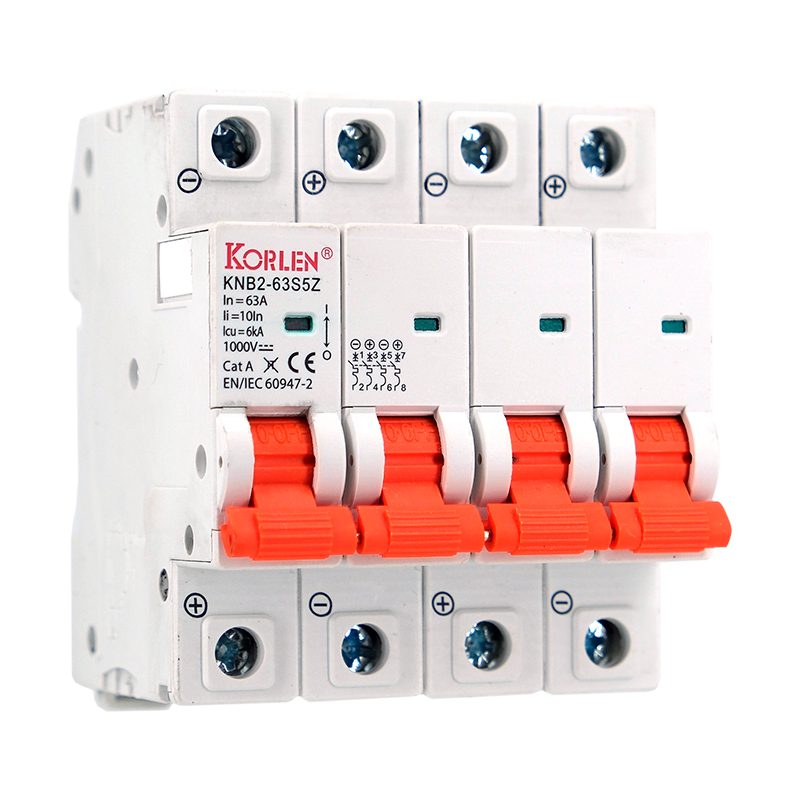
The Miniature Circuit Breakers (MCB) is a compact, modular safety switch engineered primarily for terminal protection. It is designed for fast, standardized installation on standard DIN rails.
Current & Capacity: It typically handles lower nominal currents and low-to-medium fault-breaking capacities.
Tripping Elements: It relies on fixed thermal-magnetic trip curves tailored for general distribution and lighting loads.
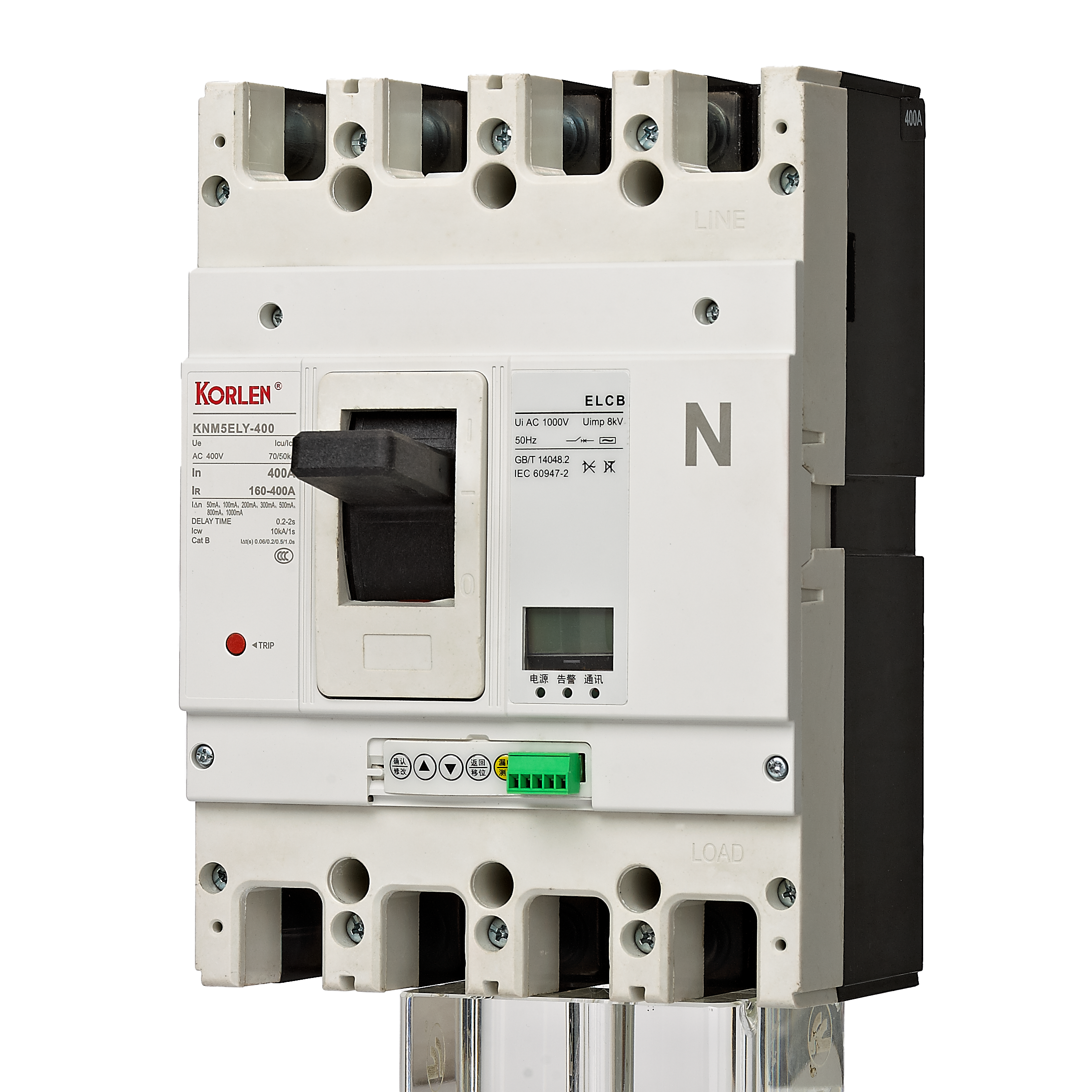
The Moulded Case Circuit Breaker (MCCB) is the heavy-duty sentinel of industrial power networks. Encased in a rugged, flame-retardant molded housing, it protects main lines and heavy industrial equipment from intense thermal overloads and massive short circuits.
Current & Capacity: It features high nominal current ratings and massive fault-interrupting capabilities.
Tripping Elements: Many models offer micro-adjustable trip units, allowing engineers to calibrate precise overcurrent thresholds based on changing operational loads.
| Electrical Parameter | Standard Korlen MCB Range | Industrial Korlen MCCB Range |
| Rated Nominal Current ($I_n$) | 0.5A to 125A | 10A up to 1600A+ |
| Interrupting Capacity ($I_{cu}$) | Typically 4.5kA to 15kA | Typically 25kA to 100kA+ |
| Trip Settings | Fixed (Type B, C, D curves) | Adjustable (Thermal & Magnetic) |
| Mounting Style | Standard 35mm DIN Rail | Baseplate / Panel Surface Bolt-On |
Because an MCCB carries a significantly higher unit price and demands a much larger physical footprint inside an enclosure, substituting it with a high-capacity Miniature Circuit Breakers (MCB) can dramatically slash project expenses. However, this substitution must be governed by strict compliance parameters.
You can legally and safely utilize an MCB instead of an MCCB if your circuit layout satisfies all three of the following criteria:
Current Demand Evaluation: The continuous operational load of the sub-circuit must fall squarely below 125A. If the nominal load is 63A or less, an MCB is the ideal, cost-effective candidate.
Short-Circuit Current Rating (SCCR) Matching: The localized potential fault current at that specific point in the system must not exceed the breaking capacity ($I_{cu}$) of the MCB. If the calculated fault level is 10kA, selecting a premium 10kA–15kA rated MCB eliminates the technical need for an MCCB frame.
Application and Circuit Boundaries: The circuit must serve as a branch or auxiliary load rather than a main building incoming feeder line. Ideal substitution applications include localized industrial lighting loops, automated control circuits, HVAC auxiliary fans, and small-scale heater banks.
By opting for modular, DIN-rail mounted MCBs over bulky bolt-on MCCBs in qualified sub-circuits, panel builders can free up to 50% of the internal cabinet space. This massive reduction in structural footprint allows OEMs to downsize the entire physical enclosure, drastically reducing steel sheet costs, freight fees, and floor space requirements on the factory floor.
[IMAGE INSERTION POINT 2]: A technical schematic layout comparison diagram demonstrating a control cabinet internal space allocation: one layout using traditional MCCBs versus a modern layout utilizing compact Korlen MCBs to free up 50% cabinet space.
When dealing with heavy-duty industrial motors, standard line protection rules change completely, introducing a third critical component: the Motor Protection Circuit Breaker (MPCB).
During startup, industrial electric motors draw an intense “inrush current” that can spike up to 6 to 10 times the normal running current. If you protect a motor feeder loop using a standard Moulded Case Circuit Breaker (MCCB) calibrated for standard cable defense, the breaker will either cause “nuisance tripping” during startup, or it must be oversized so much that it fails to protect the motor from smaller, long-term overloads.
An MPCB is specifically designed to handle motor dynamics. Unlike a standard MCCB, it features specialized trip characteristics (Class 10 or Class 20) that safely tolerate transient startup spikes while providing built-in phase failure protection. If one phase drops in a three-phase motor system, the MPCB trips instantly to prevent localized coil burnout—a safety feature that standard MCCBs cannot achieve alone.
In optimized industrial automation panels, the most efficient architecture utilizes a combined cascading strategy: a high-capacity upstream Moulded Case Circuit Breaker (MCCB) serves as the primary panel short-circuit safeguard, which then feeds downward into separate, highly tuned MPCB or MCB branches to handle localized machinery control.
When executing cost-saving component substitutions, procurement managers must partner with a supplier that never cuts corners on raw material integrity.
To ensure our compact devices safely handle mid-tier industrial fault currents, Korlen implements rigorous manufacturing controls:
International Directives: All low-voltage components are designed and tested in strict accordance with IEC 60947-2 (Industrial Power Distribution) and IEC 60947-4-1 (Motor Control Systems) standards.
Silver Alloy Contacts: We use premium silver alloy contact tips across our entire MCB product matrix, ensuring exceptionally low contact resistance and an extended mechanical lifecycle under strenuous electrical loads.
Premium Enclosures: Our breaker housings are molded from ultra-grade, flame-retardant engineering plastics, maximizing structural insulation and arc-extinguishing safety during severe short-circuit events.
[IMAGE INSERTION POINT 3]: An infographic or factory photo showcasing Korlen’s fully automated assembly line and international compliance certificates (CE, ISO, IEC) validating our product testing rigor.
Q: Is an MCCB always inherently safer than an MCB?
No. Safety is determined by correct rating calibration, not component size. If an MCB’s breaking capacity ($I_{cu}$) matches or exceeds the calculated potential fault current of the branch, it will interrupt the fault just as safely as an MCCB, while operating at a fraction of the cost.
Q: What happens if a short-circuit fault current exceeds my MCB’s capacity?
If the fault current exceeds the rated breaking capacity of the device, the internal contacts may weld together, or the housing may rupture due to excessive thermal energy. Always calculate your circuit’s maximum potential short-circuit current before substituting components.
Q: Can an MCB handle adjustable thermal-magnetic settings?
Generally, no. Standard MCBs feature fixed, pre-calibrated factory curves (such as Type B, C, or D). If your application requires precise, adjustable on-site current tuning to match a specific machine’s behavior, you must utilize an industrial Moulded Case Circuit Breaker (MCCB) or a dedicated MPCB.
Smart component selection is the ultimate key to achieving competitive, cost-effective, and ultra-compact industrial panel builds. By carefully auditing your sub-circuit currents and potential short-circuit levels, you can safely deploy space-saving Miniature Circuit Breakers (MCB) in place of heavy-frame Moulded Case Circuit Breakers (MCCB)—slashing equipment costs and downsizing cabinet footprints without ever compromising on safety compliance.
Whether you need high-breaking-capacity branch switches or rugged main industrial line protection, Korlen delivers engineered reliability that global low-voltage suppliers trust.
Optimize your system architecture and reduce structural panel expenses today—Contact Us now to receive comprehensive engineering datasheets, dimensional CAD drawings, or custom wholesale pricing!
GAONENGGELE ELECTRICAL SHARES CO.,LTD.
Privacy Policy | SiteMap
Copyright GAONENGGELE ELECTRICAL SHARES CO.,LTD.