- Whatsapp: +86 15967777035
- Email: [email protected]

In the field of electrical safety, “tripping” is a universal sign that something is wrong. However, not all trips are created equal. Understanding whether your system needs protection for its infrastructure or protection for human life is the first step in professional electrical design.
As a China Professional Circuit Breaker Manufacturer Since 1985, Korlen provides a comprehensive range of devices tailored for global industrial and residential standards. This guide focuses on the fundamental differences between the standard circuit breaker and the residual current circuit breaker (RCCB).
To the untrained eye, a standard rccb circuit breaker and a miniature circuit breaker might look similar, but their internal “missions” are worlds apart.
A standard circuit breaker is a switch that automatically interrupts the flow of electricity when it detects an overload or a short circuit. Its primary goal is to protect the wiring and equipment from catching fire due to excessive heat.
The residual current circuit breaker (rccb) is a life-safety device. Instead of looking for high current, it monitors the balance of electricity. If it detects a “leakage” (residual current) as low as 30mA—which could be flowing through a person—the rccb trips instantly to prevent a fatal electric shock.
[IMAGE INSERTION POINT 1]: A technical diagram showing the internal magnetic balance of an RCCB versus the thermal-magnetic trip unit of a standard circuit breaker.
When sourcing from suppliers, it is vital to compare these devices across three key dimensions:
| Feature | Standard Circuit Breaker | Korlen RCCB |
| Main Protection | Wire Overload & Short Circuit | Human Life & Earth Leakage |
| Detection Method | Thermal/Magnetic | Magnetic Balance (Residual Current) |
| Sensitivity | High Current (Amps) | Micro Current (Milliamps) |
| Device Type | MCB / MCCB | residual current circuit breakers |
In a professional distribution board, a single breaker rccb usually cannot do the job alone. Because a standard residual current circuit breaker does not protect against overloads, it must be paired with an MCB.
The Safety Gap: If you only have an rccb breaker, your wires could still melt during a short circuit.
The Solution: Leading suppliers recommend a tiered approach where a main AC Isolator Switch feeds into residual current circuit breakers, which then protect individual branch circuits managed by MCBs.
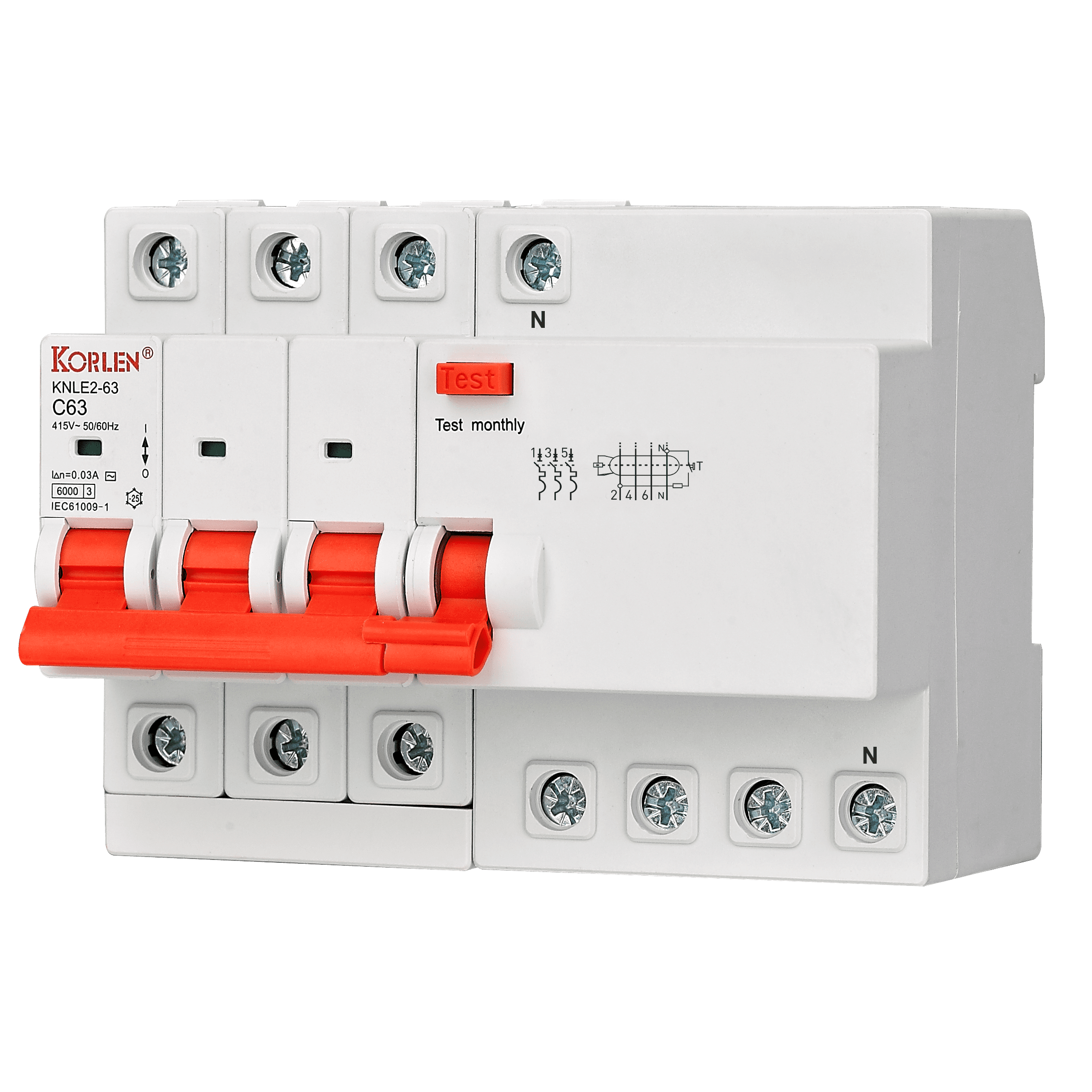
For projects with limited space, Korlen offers the RCBO. This device is the ultimate fusion, functioning as both a circuit breaker and an rccb.
Comprehensive Protection: The breaker rccb type models within the RCBO category handle leakage, overloads, and short circuits simultaneously.
Identification: When selecting an rccb circuit breaker rccb type E or other specific classes, always check the RCBO type symbols to ensure compatibility with your local grid requirements.
[IMAGE INSERTION POINT 2]: An infographic showing how one Korlen RCBO replaces the footprint of an MCB and an RCCB combined.
As a premier manufacturer, we emphasize that correct installation is as important as product quality.
How to Connect RCBO: Unlike a standard switch, a residual current circuit breaker rccb requires a dedicated neutral connection.
The Test Button: Every residual current circuit breaker features a “Test” button. This should be pressed monthly to ensure the internal mechanical link is still active.
Common Mistakes: Shared neutrals between different rccb breaker units are the leading cause of nuisance tripping in new installations.
[IMAGE INSERTION POINT 3]: A high-resolution photo of a Korlen distribution board showing the clean wiring of an isolator switch, RCCB, and several MCBs.
Q: Can I use an RCCB without a circuit breaker?
No. An rccb only detects leakage. You still need a circuit breaker to protect against short circuits and overloads.
Q: What is the difference between an RCD and an RCCB?
They are essentially the same. Residual current circuit breakers (RCCB) is the specific term for the device, while RCD (Residual Current Device) is the broader category.
Q: Why does my rccb breaker trip when I turn on my computer?
Modern electronics can have small, “normal” leakages. If too many devices are on one breaker rccb, the cumulative leakage may exceed the 30mA threshold.
Whether you are looking for a standalone residual current circuit breaker (rccb) or a complete industrial protection system, understanding these differences ensures your facility is both compliant and safe. As a global manufacturer and trusted partner to international suppliers, Korlen remains dedicated to engineering excellence.
Build a safer electrical future with Korlen—Contact Us today for wholesale inquiries, technical specifications, or custom manufacturing needs.
GAONENGGELE ELECTRICAL SHARES CO.,LTD.
Privacy Policy | SiteMap
Copyright GAONENGGELE ELECTRICAL SHARES CO.,LTD.