- Whatsapp: +86 15967777035
- Email: [email protected]

Key Takeaways
Published by the Korlen Engineering Team · Standards & Compliance · 9 min read
Category: Circuit Breakers
When a buyer asks “is this breaker IEC certified?”, the honest answer is: which IEC standard? The two most quoted low-voltage breaker standards are not competitors — they describe different product families and different installation worlds.
IEC 60898-1 — “Electrical apparatus for household and similar purposes” — applies to miniature circuit breakers (MCBs) used in homes, offices, and light commercial buildings. It defines rated voltage up to 440 V AC, the familiar B/C/D trip curves, and short-circuit capacities in the 4.5–10 kA range. Its tests assume a relatively benign, controlled environment.
IEC 60947-2 — “Low-voltage switchgear and control-gear — Part 2: Circuit-breakers” — is the general-purpose standard for circuit-breakers across industrial, commercial, and infrastructure applications. It covers MCCBs, ACBs, and MCBs used outside the domestic channel, with higher voltage ratings, harsher environmental envelopes, and coordination (selectivity, discrimination) requirements that 60898 does not address.
| Aspect | IEC 60898-1 | IEC 60947-2 |
|---|---|---|
| Product family | MCB (domestic) | MCB, MCCB, ACB (industrial) |
| Max voltage | ≤ 440 V AC | Higher (MCCB/ACB to 690 V+) |
| Trip curves | B / C / D | B / C / D + adjustable |
| Coordination | Not covered | Selectivity, type 1/2 |
| Typical buyer | Residential panel builders | OEM, EPC, industrial |
For a distributor or OEM, the standard is not academic — it is the gate to a market:
A “CE” sticker alone proves nothing — CE is a self-declaration. For B2B confidence, look for:

Korlen KNB2-63-S3 — CE / CB / SEMKO certified miniature circuit breaker
Korlen’s low-voltage range is engineered to clear both the domestic and industrial gates — MCBs carry CE/CB/SEMKO certification for the 60898 channel, while MCCBs are built to 60947-2 coordination expectations for OEM and EPC projects.
| Model | Family | Certification | Link |
|---|---|---|---|
| KNB2-63-S3 | MCB | CE / CB / SEMKO | View |
| KNM3 | MCCB | High breaking, 60947-2 class | View |
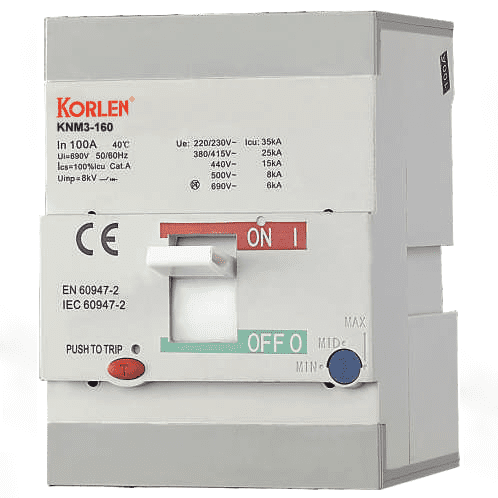
Korlen KNM3 — high-breaking-capacity MCCB for industrial distribution
Neither is “better” — they target different installations. 60947-2 covers a broader, harsher industrial envelope; 60898 is purpose-built for domestic MCBs. Many MCBs comply with both.
Usually no — 60898-1 MCBs are correct for homes. But mixed domestic/light-commercial boards often use 60947-2-rated MCBs for flexibility. See Korlen MCBs.
Because it defines coordination, selectivity, and higher breaking capacities expected in industrial and infrastructure projects where a total shutdown is unacceptable.
CE is self-declared conformity; CB is the IECEE mutual-recognition report; SEMKO is a recognized national certification body. Together they smooth customs and tender approval across Europe and Asia.
Yes. Many B2B MCBs, including Korlen’s KNB2-63-S3, are tested and marked for both the 60898 domestic channel and 60947-2 industrial expectations, simplifying dual-channel distribution.
The IEC number on a breaker is a procurement contract, not a footnote. Match the standard to the installation, confirm the certificate body your market requires, and standardize on devices that clear both channels to keep sourcing simple.
Korlen supports distributors with certification packs (CE/CB/SEMKO/SIRIM) and dual-standard documentation.
© Korlen Electric. For B2B specification reference. Confirm the applicable standard edition and certificate with your market’s authority before procurement.
GAONENGGELE ELECTRICAL SHARES CO.,LTD.
Privacy Policy | SiteMap
Copyright GAONENGGELE ELECTRICAL SHARES CO.,LTD.