- Whatsapp: +86 15967777035
- Email: [email protected]

Electric motors account for approximately 70% of industrial electricity consumption. A single unprotected motor fault can cascade into production downtime, equipment damage, and safety hazards. Choosing the wrong protection device — an MCCB where an MPCB is needed, or vice versa — leads to two equally dangerous outcomes:
Using a device with insufficient inrush tolerance causes repeated false trips during motor startup, halting production unnecessarily.
Using a device without overload or phase-loss protection allows sustained overcurrent to burn out the motor windings — a costly replacement.
The cost of a replaced 37 kW motor can exceed $2,000, plus downtime losses of $5,000–$50,000 per hour depending on the industry. Proper protection selection is not optional — it is an engineering and financial imperative.
An MPCB (Motor Protection Circuit Breaker) is a specialized device designed to protect electric motors from overloads, short circuits, phase loss, and undervoltage — all in one compact unit. Governed by IEC 60947-4-1, MPCBs are thermomagnetic breakers with motor-specific trip characteristics.
Key features of MPCBs:
An MCCB (Molded Case Circuit Breaker) is a general-purpose protection device rated for much higher currents — up to 2,500 A — governed by IEC 60947-2. MCCBs use a bimetallic strip for thermal (overload) protection and an electromagnetic component for short-circuit protection.
Key features of MCCBs:
For motor circuits specifically, an MCCB alone provides only short-circuit protection. To achieve complete motor protection (overload + short-circuit + control), you must combine it with a thermal overload relay and a contactor — a combination often called a “motor starter”.
Understanding which standard governs each device is essential for compliance and safety verification. Here is the detailed comparison:
| Dimension | IEC 60947-4-1 (MPCB) | IEC 60947-2 (MCCB) |
|---|---|---|
| Scope | Contactors and motor protection circuit breakers | Molded case circuit breakers for distribution |
| Current Range | 0.1 A — 100 A (motor-focused) | 16 A — 2,500 A (general) |
| Protection Scope | Overload + short circuit + phase loss + undervoltage | Overload + short circuit only |
| Trip Characteristic | Motor-specific (tolerates inrush 5–12×) | General (Type B/C/D curves per IEC 60898) |
| Overload Relay | Built-in — no external relay needed | External thermal relay required for motors |
| Contactor | Optional (for remote switching) | Required for motor switching |
| Phase-Loss Protection | Yes — built-in | No — requires separate relay |
| Typical Application | Individual motor protection | Distribution systems + large motor starters |
| Korlen Compliance | — (Korlen focuses on MCCB for motor protection) | CB, CE, SEMKO, SIRIM, NF, TSE, SNI, PCT certified |
The following table highlights every practical difference that affects your selection decision:
| Basis of Difference | MPCB | MCCB |
|---|---|---|
| Full Form | Motor Protection Circuit Breaker | Molded Case Circuit Breaker |
| Primary Purpose | Motor-specific protection | General circuit protection |
| Current Range | 0.1–100 A | 16–2,500 A |
| Protection Scope | Overload + short circuit + phase loss + undervoltage | Overload + short circuit (phase loss needs separate relay) |
| Overload Relay Needed? | No — built-in | Yes — external thermal relay required |
| Contactor Needed? | Optional | Required for motor switching |
| Inrush Current Tolerance | Designed for motor starting (5–12× rated) | Must be sized to avoid false trips |
| Auto-Resetting | Available in modern versions | Not available |
| Phase-Loss Detection | Built-in | Not available (needs separate device) |
| Selection Basis | Motor full-load current (FLC) + short-circuit capacity | Max load current + short-circuit breaking capacity |
| IEC Standard | IEC 60947-4-1 | IEC 60947-2 |
| Best For | Small-to-medium motors (≤55 kW) | Large motors + distribution circuits (>55 kW) |
| Compactness | Compact — all-in-one | Requires 3 separate components (MCCB + relay + contactor) |
Below are four real-world sizing calculations showing how to choose MPCB vs MCCB based on motor specifications. All examples assume 415 V 3-phase, 50 Hz, with typical starting methods.
Why MPCB wins here: The motor is within MPCB current range, and the all-in-one design saves panel space, wiring, and cost. No separate relay or contactor needed.
Decision point: At 15 kW, both options work. If you need phase-loss protection, use an MPCB. If you need the MCCB for panel standardization, combine it with a thermal relay and contactor.
Why MCCB wins here: Most MPCBs top out at 100 A. At 37 kW (67 A FLC), an MCCB-based motor starter provides higher breaking capacity and fits the typical industrial panel layout. View Korlen MCCB products for 80 A and above ratings.
Only MCCB applies: 75 kW motors exceed MPCB range entirely. Use a Type D MCCB to tolerate high inrush from DOL starting. If a soft starter or VFD is used, Type C may suffice.
Each industrial application has distinct motor characteristics and protection requirements:
Centrifugal pumps: moderate inrush (5–6× FLC), continuous duty.
MPCB for ≤15 kW; MCCB+relay for >15 kW
Variable loads, frequent starts, high ambient temperature.
MPCB for small fans; MCCB+relay for large compressors
High starting torque, heavy inrush (6–8× FLC), 30–75 kW range.
MCCB (Type C/D) + relay + contactor — mandatory
Moderate inrush, risk of jamming → sustained overload.
MPCB for small conveyors; MCCB+relay for large systems
Multiple motors, standardization preferred, PLC-controlled starts.
MCCB+relay+contactor — standard panel build
Extreme inrush (8–12× FLC), harsh environment, safety-critical.
MCCB (Type D) + relay + contactor — only option
Use this table to quickly identify the right protection approach for common motor sizes and applications:
| Motor Size | Typical FLC (415 V) | Application | Protection Type | Recommended Rating | IEC Standard |
|---|---|---|---|---|---|
| 0.75 kW | ~2 A | Small fan | MPCB | 1.6–2.5 A | IEC 60947-4-1 |
| 5.5 kW | ~11 A | Pump | MPCB | 10–16 A | IEC 60947-4-1 |
| 15 kW | ~28 A | HVAC fan | MPCB | 25–32 A | IEC 60947-4-1 |
| 37 kW | ~67 A | Compressor | MCCB + Relay + Contactor | MCCB 80 A (Type C) | IEC 60947-2 |
| 55 kW | ~100 A | Large conveyor | MCCB + Relay + Contactor | MCCB 125 A (Type C/D) | IEC 60947-2 |
| 75 kW | ~130 A | Mining conveyor | MCCB + Relay + Contactor | MCCB 160 A (Type D) | IEC 60947-2 |
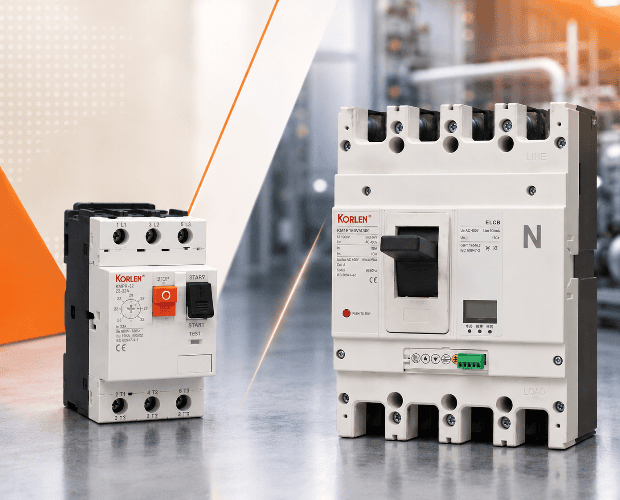
Korlen does not manufacture MPCBs — but for motors beyond 15 kW, an MCCB-based motor starter is the industry-standard protection approach. Korlen’s product range provides all three components:
Korlen KNM1 / KNM2 / KNM3 / KNM5 Series
Korlen KNC1 / KNC8 Series
External thermal overload relay
This three-component combination provides the same protection scope as an MPCB (overload + short-circuit + phase-loss + switching control), but with higher current capacity and greater breaking capacity — essential for motors above 55 kW.
Need motor protection solutions? Korlen engineers can help you configure the right MCCB + relay + contactor combination.
An MCCB without a thermal relay provides only short-circuit protection. The motor can run at sustained overload (e.g., 120% FLC) for hours before the bimetallic strip trips — by then, winding damage is already done. Always pair an MCCB with a thermal overload relay for motor circuits.
Type B MCBs/MCCBs trip at 3–5× rated current. Most motors draw 5–8× rated current during DOL starting. A Type B breaker will nuisance-trip on every startup. Use Type C (5–10×) for moderate inrush or Type D (10–20×) for heavy inrush. Read our MCB Trip Curves guide for detailed curve analysis.
A single-phase fault on a 3-phase motor causes the remaining two phases to draw excessive current, rapidly overheating the windings. MPCBs detect phase loss automatically; MCCB setups require a 3-phase thermal relay with phase-unbalance detection.
Motor kW ratings vary by voltage, efficiency class, and service factor. Always size protection based on the nameplate full-load current (FLC), not the kW rating. Two 15 kW motors at 400 V and 460 V have different FLCs and need different protection ratings.
If the prospective short-circuit current (PSC) at the installation point exceeds the breaker’s breaking capacity (Icu), the breaker cannot safely clear the fault — it may explode. Always verify PSC against Icu before finalizing a selection.
An MPCB is a motor-specific device that combines overload, short-circuit, phase-loss, and undervoltage protection in one unit. An MCCB is a general-purpose circuit breaker that requires an external thermal relay and contactor to achieve the same motor protection scope. View Korlen MCCB Products.
Yes — but only when you add a thermal overload relay and a contactor. An MCCB alone provides short-circuit protection only. The relay handles overload and phase-loss, and the contactor provides switching control. This combination is standard for motors above 55 kW. Contact Korlen Engineers for configuration help.
No. The overload protection is built into the MPCB’s thermomagnetic trip unit. This is the key advantage of MPCBs for small-to-medium motors — fewer components, simpler wiring, and lower total cost. For larger motors, see our MCB Trip Curves guide.
MPCBs are governed by IEC 60947-4-1 (contactors and motor protection circuit breakers). MCCBs are governed by IEC 60947-2 (molded case circuit breakers). Korlen MCCBs carry CB, CE, SEMKO, SIRIM, NF, TSE, SNI, and PCT certifications — all based on IEC 60947-2 compliance. Learn About Korlen Certifications.
A 5.5 kW motor at 415 V has a full-load current of approximately 11 A. For an MPCB, select a 10–16 A rated unit. For an MCCB approach, use an MCCB rated 16 A (Type C) + thermal relay (9–13 A range) + contactor (18 A). Request a Free Sample to verify your selection.
The MCCB will protect against short circuits but not against sustained overloads. The motor can run at 110–150% of rated current for extended periods, causing insulation breakdown and eventual winding failure — a costly repair or replacement. View Korlen MCCB Products with relay pairing guidance.
Yes — most modern MPCBs include built-in phase-loss / phase-unbalance detection. When one phase is lost, the MPCB trips within seconds, preventing single-phase operation that would destroy the motor windings. Contact Korlen Engineers for motor protection guidance.
MPCBs typically cover 0.1 A to 100 A (motors up to ~55 kW). MCCBs cover 16 A to 2,500 A (all motor sizes and distribution circuits). For motors above 55 kW, MCCB is the only option. Explore Korlen MCCB Range.
Short-circuit protection (magnetic trip) responds to fault currents above 5–20× rated. Overload protection (thermal trip) responds to sustained currents of 110–150% rated — levels that won’t trigger a magnetic trip but will slowly degrade motor insulation over hours. Both are essential for motor survival. See our MCB Trip Curves guide for more detail.
Korlen operates a 38,000 m² facility with 1,000+ employees and produces 150,000+ MCCBs per year. All products are tested against IEC 60947-2 and carry 8 international certifications (CB, CE, SEMKO, SIRIM, NF, TSE, SNI, PCT). Korlen’s MCCBs use pure raw materials with no recycled content, and every unit undergoes routine testing before shipment. About Korlen.
The choice between MPCB and MCCB is not about which device is “better” — it is about which device matches your motor. For small-to-medium motors (≤55 kW) where compactness and built-in phase-loss protection matter, an MPCB is ideal. For larger motors (>55 kW) and industrial distribution systems, an MCCB + thermal relay + contactor combination provides the capacity, breaking performance, and flexibility that panel builders and engineers require.
Korlen specializes in the MCCB-based approach — manufacturing KNM1/KNM3/KNM5 series MCCBs rated from 16 A to 2,500 A, paired with KNC1/KNC8 contactors and compatible thermal overload relays. All components carry international certifications and are produced under strict ISO 9001 quality management.
Korlen engineers can help you configure the right MCCB + relay + contactor combination for any motor application — from 5.5 kW pumps to 75 kW mining conveyors.
Published by Korlen Technical Team | Korlen — Leading Circuit Breaker Manufacturer Since 1985
38,000 m² facility, Wenzhou, China | ISO 9001, CB, CE, SEMKO, SIRIM, NF, TSE, SNI, PCT certified
This article is for informational purposes. Always consult a qualified electrical engineer for project-specific selections.
GAONENGGELE ELECTRICAL SHARES CO.,LTD.
Privacy Policy | SiteMap
Copyright GAONENGGELE ELECTRICAL SHARES CO.,LTD.