- Whatsapp: +86 15967777035
- Email: [email protected]

Choosing the right trip unit decides how your breaker detects and clears an overload versus a short circuit. This guide breaks down both technologies, their LSI(G) functions, and exactly when to specify each for MCCB and ACB applications.
Specifying the wrong trip unit does not just affect a line item on the bill of materials — it changes whether a fault is cleared safely and whether a non-faulted section stays energized. Two failure modes dominate:
| If you pick wrong… | Result |
|---|---|
| Thermal-magnetic on a large, selective-coordination-critical feeder | Fixed thresholds cannot be tuned → upstream breaker trips first, shutting down healthy loads. |
| Electronic on a small, fixed branch circuit | You pay 3–5× the cost for metering you will never read, and add an auxiliary-power dependency. |
The trip unit is the “brain” of the breaker. Understanding its two technologies is the fastest way to right-size protection and budget.
Before comparing trip units, separate the two faults they must handle — they have completely different physics:
Sustained overcurrent, typically 1.05×–6× rated current (In). Heat slowly degrades insulation. Requires an inverse-time trip — the higher the overload, the faster it opens. Protection must be delayed.
Extreme fault current, often > 10× In. Massive electromagnetic force and arc energy. Requires instantaneous clearing (tens of milliseconds) to limit damage and arc-flash energy. Protection must be immediate.
Both thermal-magnetic and electronic trip units cover both jobs — they just implement them with different hardware. That is the heart of the comparison.
A thermal-magnetic trip unit is fully electromechanical — no electronics, no auxiliary power.
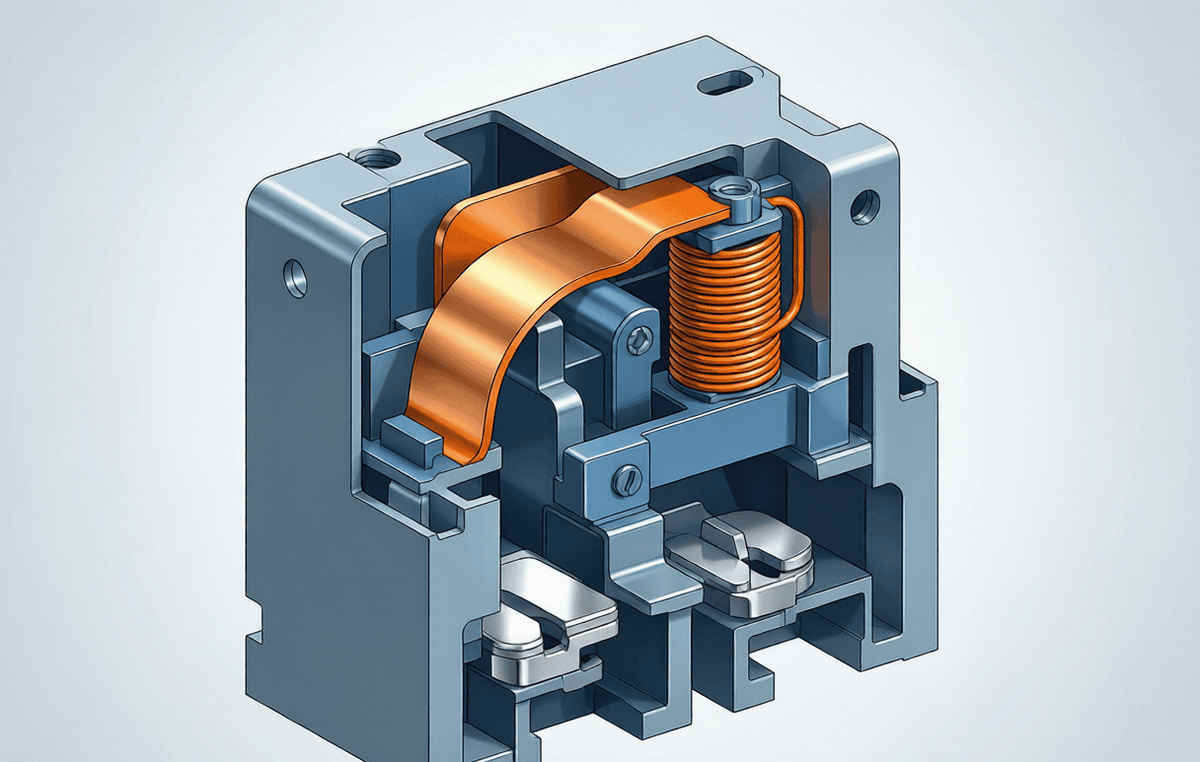
Inside a thermal-magnetic trip unit: the bimetal strip (overload) and solenoid coil (short circuit) do the work with no electronics.
Best for: feeders ≤ ~250 A, fixed-load branch circuits, cost-sensitive panels, and any location where auxiliary power is undesirable. Found standard in most MCB and economy Korlen KNM5 MCCB frames.
| Advantages | Limitations |
|---|---|
| Low cost, no auxiliary power, simple, field-proven, minimal maintenance | Fixed (or limited) thresholds, no measurement, weak selectivity, no comms |
An electronic trip unit replaces the bimetal and solenoid with a microprocessor that samples current from sensors (typically Rogowski coils or CTs) and decides when to trip. This unlocks functions impossible in pure electromechanics.
| Function | Job | Analogous to |
|---|---|---|
| L — Long-time | Overload (inverse-time) | Thermal element |
| S — Short-time | Short circuit with delay (selectivity) | — (no TMTU equivalent) |
| I — Instantaneous | Short circuit, no delay | Magnetic element |
| G — Ground-fault | Earth leakage (equipment & personnel) | External RCD needed on TMTU |
Pickup for overload typically begins at 1.075 × Ir (per IEC 60947-2); all four settings (Ir, Isd, Ii, Ig) are field-adjustable across wide ranges. Many units add metering, alarms, and a communication module for BMS integration — turning the breaker into a grid sensor.
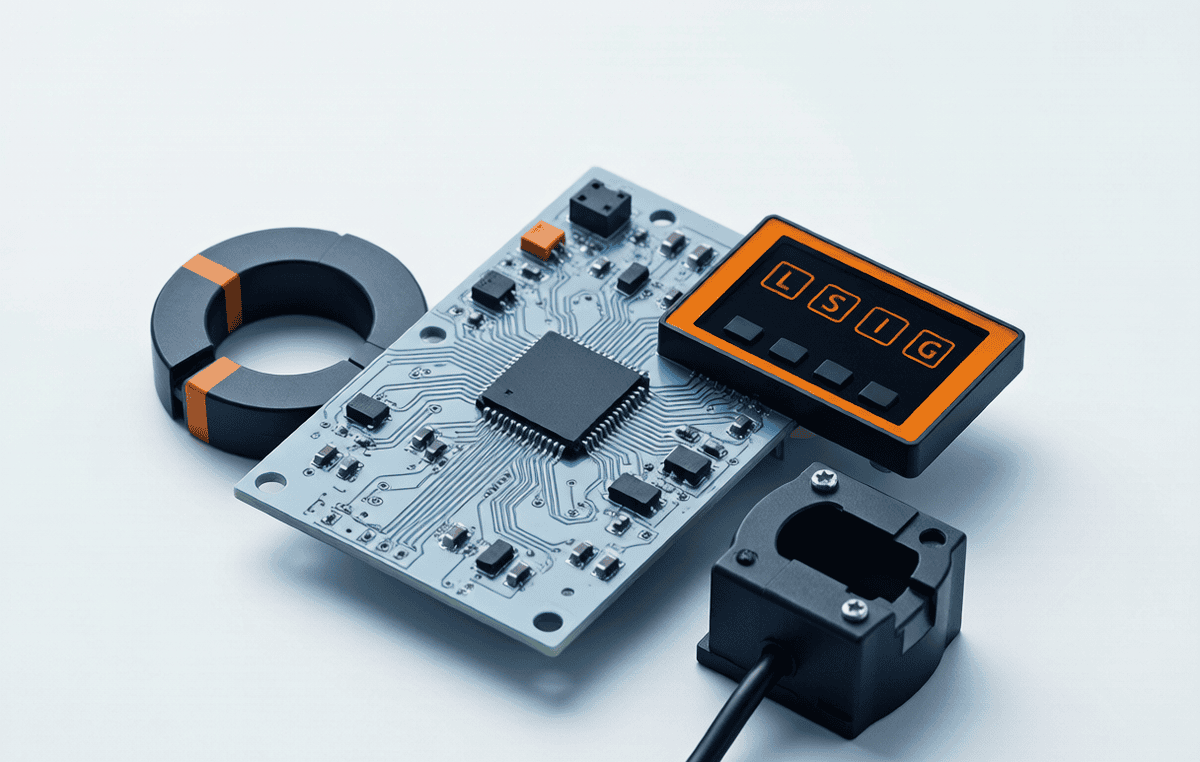
An electronic trip unit replaces the bimetal and solenoid with a microprocessor, sensors, and adjustable L S I G settings.
Best for: feeders > 250 A, ACB main incomers, critical/non-interruptible loads, and any system requiring selective coordination or ground-fault protection.
| Criterion | Thermal-Magnetic | Electronic |
|---|---|---|
| Overload mechanism | Bimetal strip | Microprocessor (L function) |
| Short-circuit mechanism | Solenoid coil | Microprocessor (S/I function) |
| Ground-fault (G) | No (needs external RCD) | Optional integrated G |
| Adjustability | Fixed / limited | Fully adjustable (Ir/Isd/Ii/Ig) |
| Measurement / comms | None | Current, energy, alarms, BMS link |
| Selective coordination | Weak (fixed curves) | Strong (adjustable delays) |
| Auxiliary power | Not required | Required |
| Typical frame size | ≤ 250 A (MCB & small MCCB) | > 250 A & all ACB |
| Relative cost | Low | High (3–5×) |
| Governing standard | IEC 60947-2 | IEC 60947-2 |
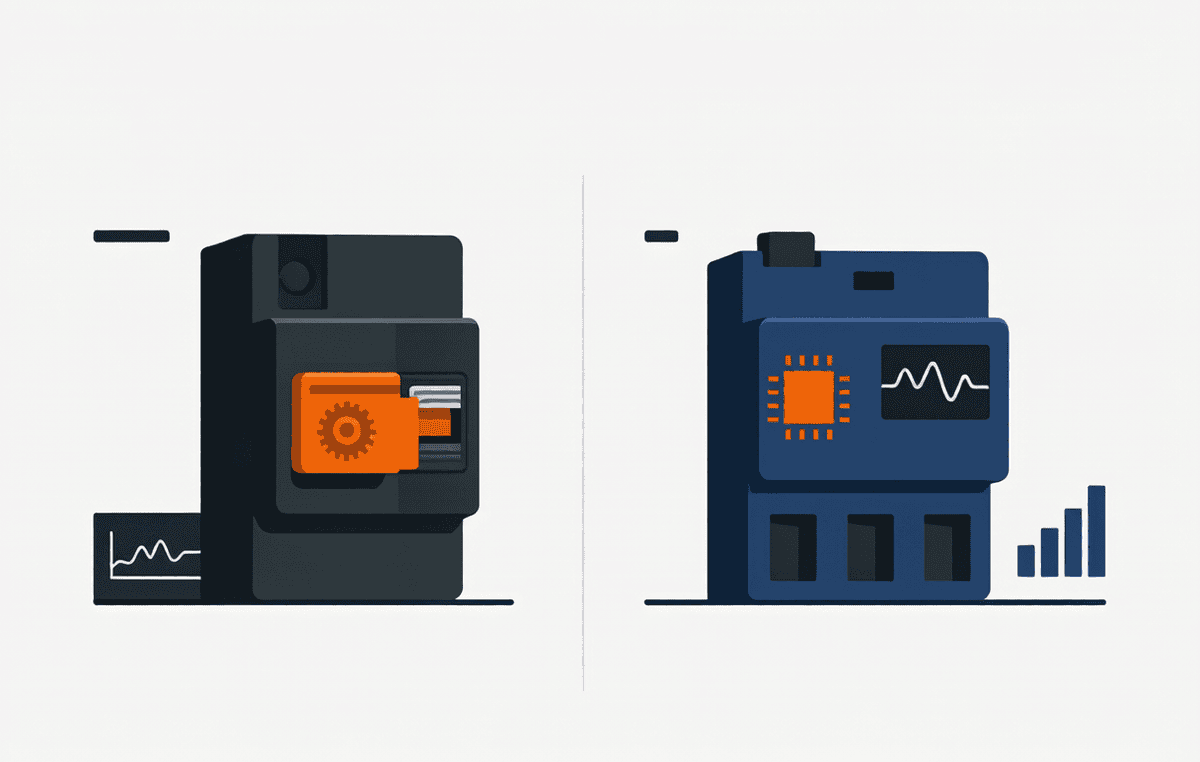
Two architectures, same jobs: thermal-magnetic (mechanical) vs. electronic (microprocessor) trip units.
Walk these five questions in order; the first “yes” to the right column points you to electronic.
If every answer points left, a thermal-magnetic unit is the economical, dependable choice — and there is no penalty for not “upgrading.”
Print or screenshot this table for field use.
| Your situation | Recommended trip unit | Why |
|---|---|---|
| Feeder ≤ 250 A, fixed load | Thermal-magnetic | Cheapest, no aux power, fully adequate |
| Feeder > 250 A or ACB main | Electronic (LSI) | Adjustable, handles high fault levels |
| Critical / non-interruptible load | Electronic | Measurement + alarms prevent downtime |
| Need selective coordination | Electronic | Adjustable S & I delays avoid cascading trips |
| Ground-fault (personnel/equipment) | Electronic (G) | Integrated G; TMTU needs external RCD |
| Remote metering / BMS | Electronic (comms) | Built-in data link |
⚠ Avoid these
Korlen manufactures both trip technologies, so you can match the unit to the application instead of the catalog:
Korlen KNM5 series MCCB frames cover branch and sub-main duties. Economy frames ship with thermal-magnetic trip; larger frames offer adjustable electronic (LSI) units for selective coordination.
Korlen ACB main breakers are built around microprocessor trip units with adjustable long-time, short-time, instantaneous and optional ground-fault protection — engineered for selective main-incomer duties.
Note: the Korlen KNM5 MCCB series (thermal-magnetic and electronic-ready frames, 10–1250 A) is one confirmed option; confirm exact trip-unit availability for your chosen frame with the Korlen catalog before specifying.
A thermal-magnetic unit uses a bimetal strip for overload and a solenoid for short circuit — fully mechanical and fixed. An electronic unit uses a microprocessor to deliver adjustable L/S/I/G protection plus metering. See the Korlen MCCB range for both options.
Overload heats the bimetal until it bends and trips (inverse-time); a short circuit drives the solenoid, which yanks the trip bar in milliseconds. It is the standard mechanism in most Korlen MCB and small MCCB frames.
L = long-time (overload), S = short-time (selective short circuit), I = instantaneous (short circuit), G = ground-fault. Together they replace and extend the thermal + magnetic functions. Explore them on the Korlen ACB electronic platform.
Choose electronic when current exceeds ~250 A, when you need selective coordination, ground-fault protection, metering, or BMS integration. Browse the full Korlen low-voltage circuit-breaker catalog to compare.
No — a thermal-magnetic unit has no ground-fault function. You must add an external RCD, or specify an electronic unit with the G function. The Korlen ACB offers integrated G protection.
Yes — Ir, Isd, Ii and Ig are all field-adjustable across wide ranges, usually via a front dial or communication module, with no change of hardware. See how on the Korlen ACB trip-unit settings.
Thermal-magnetic is mechanically simple and needs no power, so it excels in harsh or power-less environments. Electronic units are more capable but depend on auxiliary supply. Korlen holds ISO 9001, CB, CE, SEMKO, SIRIM, NF, TSE and SNI certifications — see About Korlen.
A practical rule is ~250 A: below it thermal-magnetic is usually sufficient and economical; above it electronic trip units become the norm for coordination and fault management. Confirm frame sizes in the Korlen low-voltage catalog.
Yes. Korlen MCCB offers electronic (LSI) options on larger frames, and Korlen ACB uses microprocessor trip units as standard. Compare both:
View Korlen KNM5 →View Korlen ACB →
Trip units are governed by IEC 60947-2 (low-voltage switchgear — circuit-breakers) and, in North America, UL 489. Korlen components carry the relevant certifications — see the Korlen certifications page.
Thermal-magnetic and electronic trip units solve the same two problems — overload and short circuit — with different hardware. Pick thermal-magnetic for simple, fixed, low-current feeders; pick electronic for larger frames, selectivity, ground-fault, and metering. Match the unit to the duty, not the price tag.
Need help matching a thermal-magnetic or electronic trip unit to your MCCB or ACB application? Our engineering team can build the bill of materials.
View Korlen KNM5 →
View Korlen ACB →
Need a tailored configuration? Contact the Korlen engineering team.
© Korlen Electric. Technical content for B2B specification guidance — verify trip-unit availability against the current product catalog before ordering.
GAONENGGELE ELECTRICAL SHARES CO.,LTD.
Privacy Policy | SiteMap
Copyright GAONENGGELE ELECTRICAL SHARES CO.,LTD.