- Whatsapp: +86 15967777035
- Email: [email protected]

In modern electrical systems, safety, reliability, and efficiency are critical. One of the most important protection devices ensuring these factors is the Miniature Circuit Breaker (MCB).
If you’ve ever wondered what is a circuit breaker and how does it work, it is essentially an automatically operated electrical switch designed to protect circuits from damage caused by overcurrent, including overloads and short circuits. The MCB full form in electrical terminology stands for “Miniature Circuit Breaker,” and it has become the standard low voltage circuit breaker supplier solution worldwide.
Unlike traditional fuses, which must be replaced after a fault, MCBs offer:
Reusable protection: No replacement needed after tripping.
Faster and more precise tripping: Enhanced response to fault conditions.
Improved operational safety: No exposed melting parts or fire hazards.
Lower long-term maintenance cost: Ideal for high-uptime environments.
From residential buildings to commercial facilities and heavy industrial systems, MCBs are the cornerstone of distribution system protection devices.
Understanding the working principle of miniature circuit breaker technology is essential for selecting the right protection device. An MCB integrates two independent protection mechanisms to provide comprehensive safety:
Thermal Protection (Overload): This handles sustained overcurrents. A bimetallic strip heats up and bends when current exceeds the rated value over time. This delayed response is crucial as it prevents “nuisance tripping” during brief, harmless power surges.
Magnetic Protection (Short Circuit): This handles sudden, massive surges. A solenoid coil reacts instantly to high fault currents, triggering an electromagnetic force that causes immediate disconnection within milliseconds.
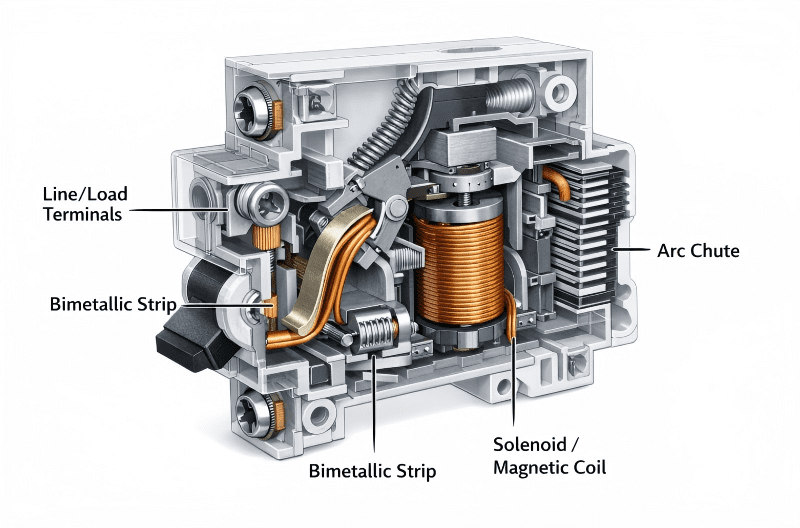
To understand how circuit breaker works step by step, we must examine the internal mechanical sequence that allows the device to isolate faults:
Fault Detection: The bimetallic strip senses excess heat from an overload, while the solenoid coil detects the intense magnetic field of a short circuit.
Mechanical Actuation: Once the fault reaches a specific threshold, the sensing element pushes against the trip bar to release the spring-loaded mechanical latch.
Contact Separation & Quenching: The moving contacts are rapidly pulled away from the fixed contacts. As they separate, an electrical arc jumps the gap and is immediately drawn into the arc chute to be split and extinguished safely.
Complete Isolation: The toggle moves to the “OFF” position, effectively protecting your downstream equipment from terminal damage.
Summary: MCB Operational Logic Table
| Condition | What Happens Inside the MCB | Result |
| Normal Operation | Current flows steadily through closed contacts. | Circuit remains ON and stable. |
| Overload | Bimetal strip bends due to excess heat over time. | Trips with delay to protect cables. |
| Short Circuit | Magnetic coil activates instantly via solenoid. | Immediate trip in milliseconds. |
| Arc Quenching | Arc Separation: Arc is split in the chute. | Safe extinguishing prevents melting. |
| Fault Cleared | The mechanical latch is manually re-engaged. | Circuit restored to normal state. |
There are several specialized types of miniature circuit breakers categorized by their “tripping curves.” Choosing the correct curve is essential to ensure the best miniature circuit breaker for industrial use while avoiding false trips.
| Type | Trip Range (Rated Current) | Typical Application |
| Type B | $3 – 5 \times I_n$ | Residential lighting and resistive circuits. |
| Type C | $5 – 10 \times I_n$ | Commercial offices and small motor loads. |
| Type D | $10 – 20 \times I_n$ | Heavy industrial equipment and transformers. |
Type B: These units are designed for low surge environments. They are primarily used for residential wiring where surge currents are minimal.
Type C: These breakers are the ideal choice for commercial and light industrial loads that experience moderate inductive surges.
Type D: This category is widely considered the best miniature circuit breaker for industrial use involving high startup surges from motors or X-ray machines.
When evaluating your options, it is important to understand the difference between MCB and fuse technology as well as the mcb vs mccb difference.
The primary difference between MCB and fuse technology lies in reusability. A fuse melts and must be replaced; an MCB is a permanent switch. MCBs provide much better long-term cost efficiency and superior protection for sensitive electronics.
The mcb vs mccb difference is largely defined by current capacity. MCBs are for low-voltage applications up to $125A$, whereas Molded Case Circuit Breakers (MCCB) handle up to $2500A$ and often feature adjustable trip settings for complex industrial power grids.
| Feature | MCB | MCCB |
| Current Rating | Up to $125A$ | Up to $2500A$ |
| Trip Settings | Usually fixed | Often adjustable |
| Application | Domestic/Light Commercial | Heavy Industrial/Mains |
For engineers, knowing how to identify mcb rating is the first step toward safety. Look at the front casing: a code like “C16” means a Type C curve with a 16A rated capacity.
Power Down: Always ensure the main power supply is completely OFF to prevent shock.
DIN Rail Mounting: Align the rear clip with the standard rail and press until you hear a “click.”
Wiring: Insert the “Line” wire into the top and the “Load” wire into the bottom terminal.
Terminal Tightening: Secure the screws to the specified torque to prevent loose connections.
Final Testing: Switch the toggle to “ON” and verify continuity with a multimeter.
Finding a trustworthy low voltage circuit breaker supplier ensures system stability. As a prominent circuit breaker factory China based with a global footprint, Korlen provides the volume and quality required for modern infrastructure.
OEM Miniature Circuit Breaker Manufacturer: We offer custom technical specifications and private labeling for global partners.
Industrial Circuit Breaker Supplier: Our products are fully compliant with international IEC 60898-1 and CE safety standards.
Buy MCB Online Bulk: We provide a streamlined portal to buy mcb online bulk with guaranteed lead times for wholesalers.
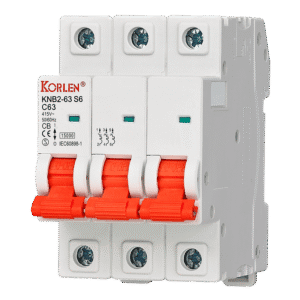
Choosing the right model is critical for performance and safety. Below are the primary Korlen MCB solutions trusted by global wholesalers and contractors:
Range: 6A–63A
Best For: Standard residential and light commercial distribution. It is highly cost-effective and features a reasonable structure for easy DIN rail installation.
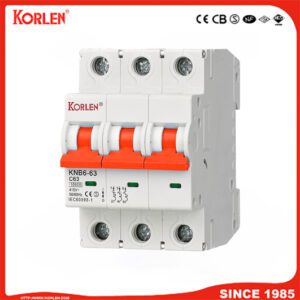
Capacity: Up to 15kA breaking capacity.
Best For: Demanding industrial environments where higher short-circuit protection is mandatory
Q1: What is the primary difference between an MCB and a fuse? An MCB can be manually reset after a fault, while a fuse must be replaced once it melts.
Q2: How do I choose the right tripping curve (Type B, C, or D)? Select Type B for residential, Type C for commercial, and Type D for high-surge industrial loads.
Q3: Can an MCB be used for both AC and DC circuits? No, you must use a specialized DC MCB for DC applications to ensure proper arc quenching.
Q4: How can I identify the current rating of an MCB? The rating is found on the front casing, with “C16” representing a 16-Ampere Type C breaker.
Miniature Circuit Breakers are essential for modern safety. Whether you are a contractor or an OEM brand, choosing the right mcb manufacturer and industrial circuit breaker supplier will directly impact your project success.
[Contact Korlen Today] – Your premier circuit breaker factory China / global partner for all electrical protection needs!
GAONENGGELE ELECTRICAL SHARES CO.,LTD.
Privacy Policy | SiteMap
Copyright GAONENGGELE ELECTRICAL SHARES CO.,LTD.