- Whatsapp: +86 15967777035
- Email: [email protected]

A practical selection guide for solar, storage, EV and building panels — by Korlen
Choosing between an AC miniature circuit breaker (MCB) and a DC MCB looks like a one-letter decision. It is not. The physics of the current they switch is fundamentally different, and using the wrong type where DC is present is a documented fire hazard. This guide explains the difference in plain terms, then gives you a practical checklist and Korlen’s real product data so you can specify with confidence.
Too long to read?
AC MCBs quench the arc at the current’s natural zero-crossing (twice per cycle). DC has no zero-crossing, so a DC MCB adds a bigger arc chamber, wider contact gap and a magnetic blow-out coil — and its wiring polarity matters. Match the breaker to the current type, the voltage, and the standard (IEC 60898 for AC, IEC 60947-2 for DC).
Alternating current reverses direction 50 or 60 times per second. Direct current flows one way and stays there. That single fact drives everything else about breaker design.
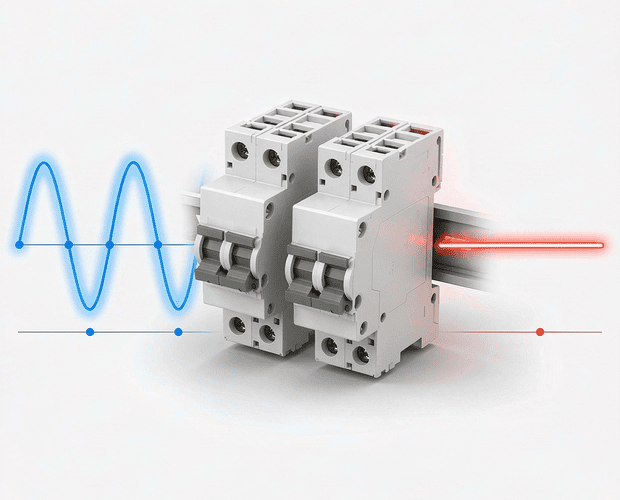
AC
zero-crossing every half-cycle
DC
no zero-crossing — arc must be forced out
Illustration: why DC interruption is harder
The blue curve is AC: it passes through zero voltage regularly. The red line is DC: it never crosses zero. When a breaker opens, an electric arc forms as the contacts separate. For AC, the next zero-crossing arrives within milliseconds and the arc dies naturally. For DC, nothing forces the arc to stop — it keeps burning until the breaker mechanically stretches and cools it into extinction.
The MCB replaced the rewireable fuse in the early 20th century because it is resettable and far safer to maintain. Early units were AC-only, designed for the 50/60 Hz grids that powered homes and factories. As photovoltaic arrays, battery storage and EV chargers pushed DC into everyday installations, manufacturers had to redesign the breaker for a current that never lets go. The result is the DC MCB — visually similar, internally very different.
An AC MCB trips on two independent principles:
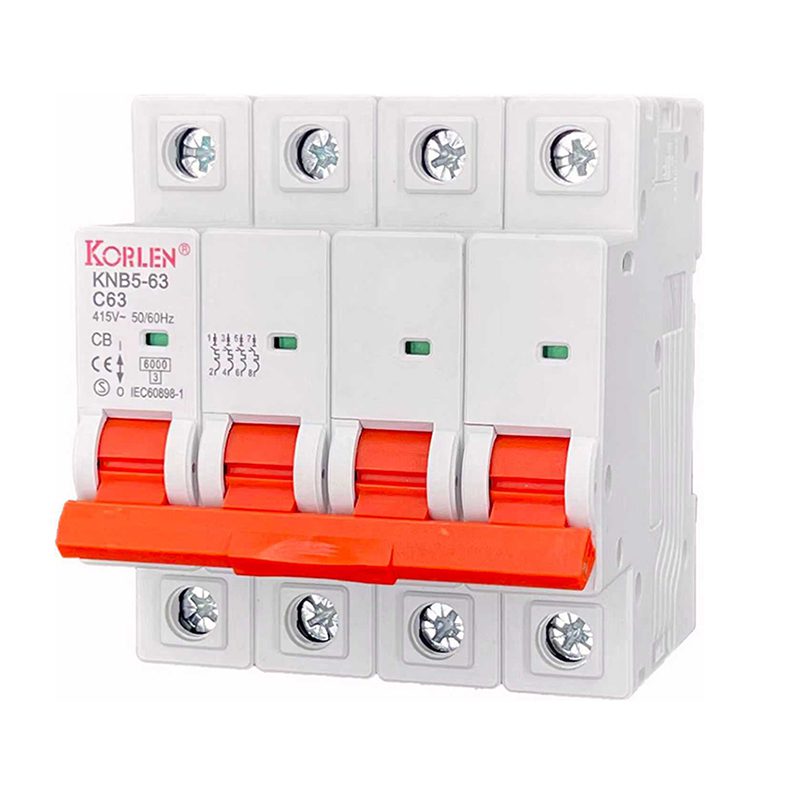
Once the contacts part, the arc is drawn into a stack of splitter plates (the arc chute). Because the AC current is about to hit zero anyway, the plates only need to cool and divide the arc briefly. That is why an AC MCB can be compact and inexpensive. Korlen’s KNB5-63 AC MCB is a 6 kA device built on exactly this principle, rated to 415 V AC across 1–4 poles.
With no zero-crossing to help, a DC MCB needs three extra design moves to extinguish the arc:
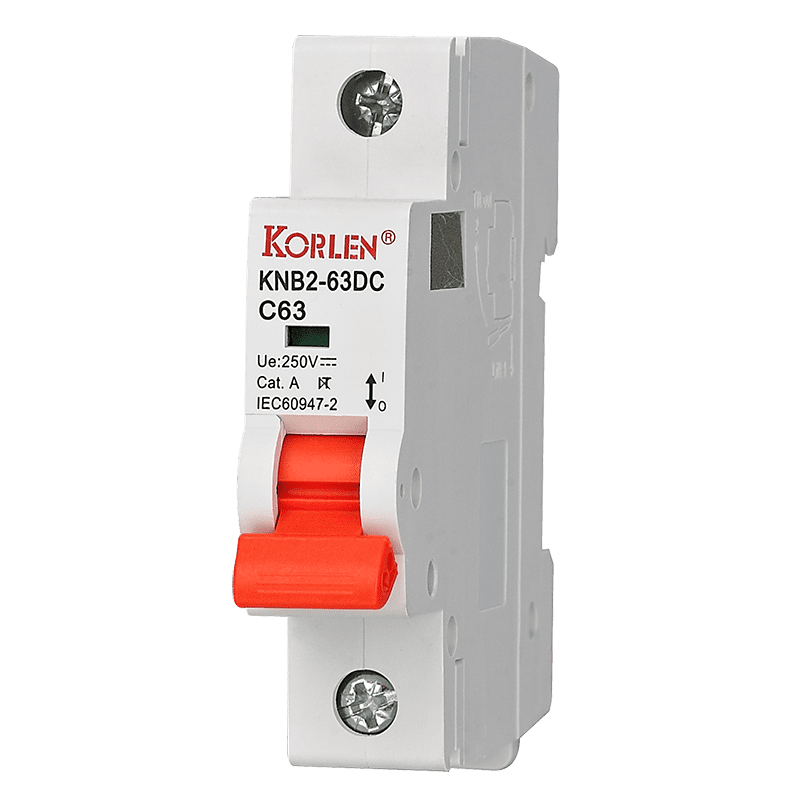
That same magnet makes DC MCBs polarity-sensitive. The + and − terminals must be wired as marked; reversed wiring defeats the blow-out and can leave the arc burning — a real fire risk. Korlen’s KNB2-63DC is rated up to 1000 V DC and complies with IEC/EN 60947-2, the standard written for DC switching.
Rule of thumb
If the circuit can ever carry DC — even a battery backup on an otherwise AC panel — use a DC-rated breaker on that branch. Never substitute an AC MCB in a DC path.
Photovoltaic (PV)
DC strings from panels to inverter — DC MCB + surge protection.
Battery storage
DC bus between cells and inverter; polarity-correct DC MCB.
EV charging
DC fast-charge side needs DC-rated protection.
Residential AC
Lighting, sockets, AC appliances — standard AC MCB.
Industrial AC
Machinery, motors, distribution boards.
Data centers
AC backbone + DC backup rails.
Most export markets (Europe, Asia, Middle East, Latin America) follow IEC. North America follows UL. Korlen products are built to IEC/EN, which is what the majority of global buyers specify:
If you sell into the US, confirm the UL 489 / UL 1077 listing separately — that is a different certification track from IEC.
AC MCB in DC
Using an AC breaker on a PV string — the arc never clears.
Reversed DC polarity
Defeats the blow-out coil; arc lingers at contacts.
Wrong voltage
An AC 240 V rating is not a DC 240 V rating.
No DC surge
DC sides need SPD; pair with a Type 2 device.
Korlen manufactures both sides of the line, so you can standardise the panel:
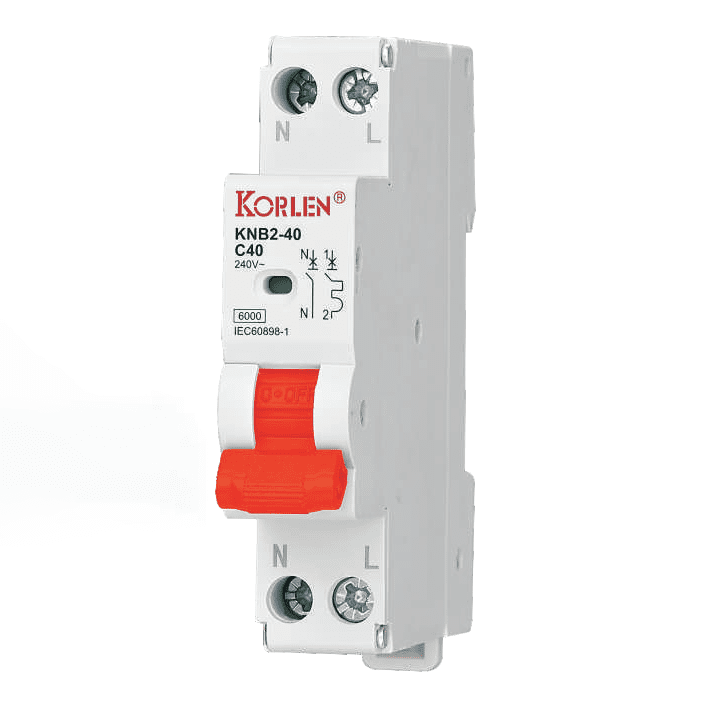
Note the DC unit’s 20,000 mechanical operations versus 10,000 on the AC unit — DC mechanisms are built tougher because the arc is harder to kill.
Some dual-rated breakers exist, but the DC voltage rating is far lower than the AC one (e.g. 277 V AC ≈ 60 V DC on the same pole). For real DC work — PV, storage — use a purpose-built DC MCB such as the KNB2-63DC.
The larger arc chamber and blow-out magnet take space. That bulk is the price of safe DC interruption.
Yes. Reverse the terminals on a DC MCB and the magnetic blow-out works against the arc instead of with it. Always follow the marked + / −.
Specifying a mixed AC/DC panel? Korlen’s engineering team can confirm ratings, polarity and standards for your market — including DC surge protection with the KNY-40 Type 2 SPD and DC isolation with the KNH2-100 isolator.
GAONENGGELE ELECTRICAL SHARES CO.,LTD.
Privacy Policy | SiteMap
Copyright GAONENGGELE ELECTRICAL SHARES CO.,LTD.