- Whatsapp: +86 15967777035
- Email: [email protected]

Driven by the global transition toward renewable solar energy infrastructure, electric vehicle (EV) fast-charging networks, and commercial battery storage systems (BESS), procurement teams are encountering a major technical trap: treating alternating current (AC) and direct current (DC) miniature circuit breakers as interchangeable components.
Because AC MCBs and DC MCBs often feature near-identical structural plastic enclosures and standard DIN-rail clip formats, busy global buyers frequently source lower-cost AC variants to deploy inside high-voltage DC combiners or battery banks. This is a severe code violation. The physics governing how alternating voltage and direct current behave during a short-circuit fault are entirely distinct. As a globally certified China Professional Circuit Breaker Manufacturer since 1985, Korlen breaks down the internal engineering differences you must understand to future-proof your low-voltage supply chain.
The defining difference between switch and circuit breaker design for AC and DC environments centers not on how they trip, but on how they quench the destructive plasma arc created when the internal metal contacts separate under load.
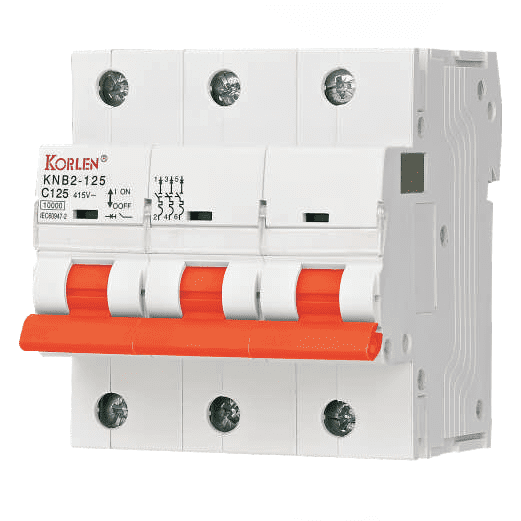
Alternating current is naturally cooperative. Standard 50Hz or 60Hz power lines oscillate, meaning the current waveform reverses direction and drops to zero amplitude 100 to 120 times every single second. This phenomenon is known as the **”Natural Zero-Crossing Point.”**
When an AC breaker opens to clear a fault, it waits for this precise millisecond zero-crossing window. The electrical arc naturally suffocates and dies out because the driving voltage momentarily hits zero. The breaker’s arc chute simply cools the remaining plasma down to keep it from restriking. For standard grid operations, review our highly reliable Miniature Circuit Breakers (MCB) terminal line.
Direct current does not cooperate. It flows with a constant, unyielding amplitude in one singular direction. There is zero oscillation and no natural zero-crossing point. It is a continuous rushing river of energy.
When a breaker tries to disconnect a DC fault under load, the plasma spark is incredibly violent and refuses to go out on its own. If you mistakenly install a generic AC breaker in a DC application, the arc will remain active inside the chamber, causing the casing to melt, catching fire, and destroying the entire distribution cabinet. If your system requires heavy physical manual isolation alongside your automated DC loops, explore Korlen’s heavy-duty isolating switch configurations.
Because direct current arcs are exceptionally stable, specialized internal component engineering is required to force the circuit open safely under a heavy short circuit.
Because DC breakers rely on integrated permanent magnets to pull the arc into the cooling plates, the majority of industrial DC MCBs are strictly polarity-sensitive. The terminal housings are explicitly stamped with plus (+) and minus (-) symbols. Sourcing teams must warn installers that wiring a polarity-sensitive DC breaker backward completely reverses the internal magnetic force. Instead of pushing the plasma arc into the cooling chamber, the magnet will pull the arc toward the interior mechanical linkages, causing the breaker to fail catastrophically during its very first trip event.
For high-capacity, heavy industrial branch control where multi-pole coordination and robust isolation handles are mandatory, specify Korlen’s advanced Moulded Case Circuit Breaker (MCCB) system setups.
When cross-referencing low-voltage suppliers to fulfill commercial or industrial bills of materials (BOM), utilize this clean engineering grid to cross-examine technical specifications:
| Technical Parameter | Standard AC MCB (e.g., Korlen Series 1100) | Specialized DC MCB (e.g., Korlen Series 1110) |
|---|---|---|
| Arc Interruption Strategy | Relies on natural zero-crossing points (50/60 Hz cycles) | Forced Magnetic Blowout Coils/Permanent Magnets |
| Wiring Directionality | Line/Load bi-directional (Non-polarized) | Strictly Polarized (+ and – markings must be observed) |
| Core Application Scope | Grid power, residential appliances, commercial lighting | Solar arrays, battery networks (BESS), EV chargers, Telecom |
| Sourcing Cost Profile | Standard economical baseline due to simple metallurgy | Premium cost profile due to permanent magnet integration |
Understanding when to implement a disconnect switch instead of a circuit breaker or choosing between AC and DC protection lines shouldn’t require balancing multiple erratic component vendors.
As modern distribution panels increasingly evolve into hybrid layouts—where an incoming AC supply path feeds industrial rectifiers that convert power for local DC motor networks—procuring your entire breaker matrix from a singular, vertically integrated complete package electrical switchgear component manufacturer like Korlen eliminates component sizing friction. It unifies all regulatory testing paperwork (CE, ISO, IEC compliance tracks) under one single audit profile and sharply drops your procurement logistics costs.
Verify your current system requirements by running through this engineering checklist before ordering bulk stock:
Only at exceptionally low voltages (typically under 24V or 48V depending on specific manufacturer ratings) and very low prospective fault currents. For anything above these levels, an AC breaker cannot clear a continuous DC arc and poses a massive fire risk.
Because their interior chassis requires specialized permanent magnets, precise silver alloy contacts, and longer, reinforced arc chutes to actively stretch and quench unyielding direct current faults.
The internal permanent magnet will pull the arc toward the delicate mechanical actuator components instead of pushing it out into the arc grids, leading to catastrophic component melting and a complete failure to clear the short circuit.
Yes. Non-polarized DC breakers use complex dual-mirror arc extinguishing chambers to handle bi-directional current flows (common in battery setups that charge and discharge), but they command a higher price premium.
Always inspect the front printing interface. A DC breaker will clearly state a DC voltage rating ($V_{dc}$ or a straight line symbol ⎓) and will feature explicit “+” and “-” polarity symbols next to the terminal screw ports.
Yes. As an established factory plant, Korlen manufactures a complete line of high-grade AC terminal breakers alongside specialized high-voltage DC miniature circuit breakers tailored for modern solar and BESS installations.
While physically possible since the AC current will naturally cross zero and help extinguish the arc, the overcurrent trip curves inside a DC breaker are calibrated differently due to the lack of AC root-mean-square (RMS) thermal characteristics. It is never recommended without explicit manufacturer derating verification.
Ensure your supplier provides verified documentation tracking standards like IEC 60947-2 (for industrial breaker parameters) or specialized photovoltaic standards like UL 489B for North American markets.
The arc chute consists of a series of parallel insulated metal plates. When the arc is driven into the chute, it is split into multiple smaller, separate arcs. This dramatically multiplies the arc voltage and cools the plasma down below its ionization threshold.
Package sourcing guarantees absolute dimensional matching (such as busbar spacing and auxiliary contact fitment), simplifies your logistical customs clearance, and opens up access to high-tier factory-level wholesale volume discounts.
Eliminating electrical selection mistakes is the fastest path to safeguarding industrial personnel and securing corporate asset value. Forcing an AC breaker to work inside a continuous, high-energy direct current loop is a severe hazard that leads to early system degradation and catastrophic fire risks.
Partnering with a reliable, factory-direct **complete package electrical switchgear component manufacturer** ensures your facilities operate under ideal safety parameters while bringing robust predictability to your international procurement pipeline.
Access factory-direct bulk volume pricing, certified international compliance paperwork, and comprehensive 2D/3D CAD blueprint drawings for your hybrid AC/DC panel layouts.
GAONENGGELE ELECTRICAL SHARES CO.,LTD.
Privacy Policy | SiteMap
Copyright GAONENGGELE ELECTRICAL SHARES CO.,LTD.