- Whatsapp: +86 15967777035
- Email: [email protected]

Key Takeaways
Published by the Korlen Engineering Team · System Coordination · 9 min read
Category: Circuit Breakers
Discrimination — also called selectivity — is the ability of a protection system to isolate a fault at the precise point where it occurs, and nowhere else. If a motor branch shorts out, only that branch’s breaker should trip. The feeder breaker above it, and the main incomer, must stay closed so the other 47 circuits keep running.
When selectivity is absent, the fault current is high enough to operate both the branch and the upstream breaker — and the upstream one wins the race to clear it, blacking out everything downstream. In a hospital operating theatre or a server hall, that “upstream trip” is a catastrophe, not a nuisance.
Three typical root causes:
Selectivity is achieved two ways, often combined:
Full vs partial selectivity: “full” means selectivity holds for every fault current up to the upstream Icu; “partial” holds only up to a defined lower current. Partial selectivity is common and cost-effective where the maximum likely fault is bounded.
Cascading (sometimes called “discrimination by energy limitation”) is a smarter trick. A current-limiting upstream MCCB clips the fault current so drastically that the downstream MCB — even if it would normally see a destructive let-through — only experiences a small, safe current. The downstream device is thus “backed up” by the upstream limiter and need not be sized for the full short-circuit level.
The payoff: you can use smaller, cheaper MCBs downstream while still meeting the board’s overall breaking requirement, provided the manufacturer’s cascade table is respected. Korlen publishes cascade coordination between its MCCBs and MCBs so panel builders can verify the combination.
| Layer | Device | Tuning for selectivity |
|---|---|---|
| Branch | MCB | Lowest rating, fast curve |
| Feeder | MCCB | Higher rating + selectivity delay |
| Main incomer | MCCB / ACB | Current-limiting, time-graded |
Korlen’s MCCB and ACB families are built for exactly this hierarchy — current-limiting MCCBs up top, selective grading through the feeder, compact MCBs at the branch.
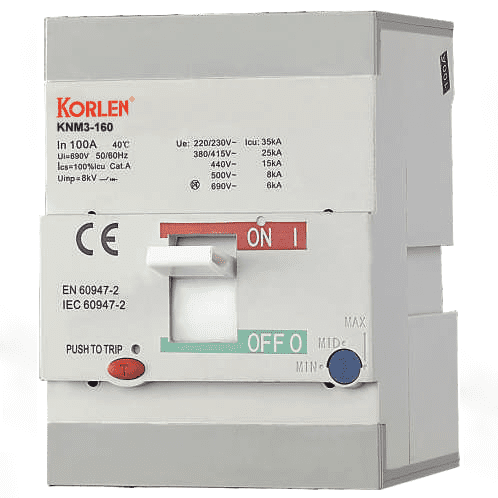
Korlen KNM3 — high-breaking MCCB for feeder / selectivity layer
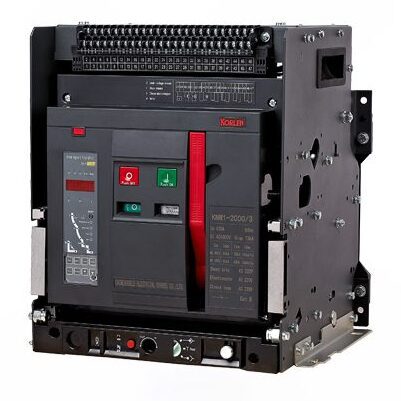
Korlen KNW1 — universal intelligent ACB for main incomer coordination
| Model | Role | Link |
|---|---|---|
| KNM3 | Feeder / current-limiting MCCB | View |
| KNW1 | Main incomer ACB | View |
Selectivity keeps the upstream breaker closed by grading; cascading uses an upstream current-limiting breaker to slash the fault energy the downstream device sees. They are often combined in one board.
Yes, for many commercial boards, provided the maximum credible fault stays within the partial-selectivity current. Full selectivity is reserved for critical loads (hospitals, data centers).
Use the manufacturer’s published cascade/coordination table — never assume. Korlen provides MCCB–MCB coordination data for its range.
Yes. An ACB like Korlen’s KNW1 at the incomer adds precise time grading and high Icu, making full selectivity down to the feeders practical. See KNW1.
Almost always a missing rating or time grade between branch and feeder. Re-grade the feeder with a selectivity delay or a clearly higher frame size.
Selectivity is what turns a fault from “one circuit down” into “one circuit down, everything else fine.” Design the grade deliberately — current, time, or cascade — and verify it against the manufacturer’s coordination tables before the board is built.
Korlen engineers will review your grading and supply the cascade coordination table for your exact device combination.
© Korlen Electric. For B2B specification reference. Always verify selectivity against the latest manufacturer coordination tables and local standards.
GAONENGGELE ELECTRICAL SHARES CO.,LTD.
Privacy Policy | SiteMap
Copyright GAONENGGELE ELECTRICAL SHARES CO.,LTD.