- Whatsapp: +86 15967777035
- Email: [email protected]

Key Takeaways
Published by the Korlen Engineering Team · Energy Storage · 10 min read
Category: DC Protection
A grid-tied BESS chains three domains: the battery stack (DC), a DC bus / combiner, a bi-directional PCS (power conversion system) that inverts to AC, and the AC connection to grid or load. Every DC junction — between modules, at the string combiner, and at the PCS DC input — needs overcurrent protection.
Critically, the DC current is bidirectional: it flows battery→bus→PCS while discharging, and PCS→bus→battery while charging. A fault or a control error can reverse flow in milliseconds, which is why BESS protection is harder than PV.
Battery cells can deliver enormous fault current — limited mainly by internal resistance and cabling. Common overcurrent events:
The DC breaker must interrupt this current even though, unlike AC, there is no natural current zero to help quench the arc.
Reverse current protection addresses scenarios where current flows the “wrong” way:
A DC breaker specified for BESS must therefore be validated for fault interruption in both polarities, not just one direction.
| Aspect | PV string | BESS DC side |
|---|---|---|
| Current direction | One-way (array → inverter) | Bidirectional (charge/discharge) |
| Fault energy | Limited by panel Isc | Very high (low-impedance cells) |
| Key risk | OC voltage arc | Overcurrent + reverse/back-feed |
| Breaker need | DC MCB, polarity marked | DC MCB, bidirectional-validated |
Korlen’s DC miniature circuit breakers are built for photovoltaic and battery-side DC protection — deep arc chutes, magnetic blow-out, and polarity marking for safe DC interruption.

Korlen KNB2-63DC — 6 kA DC MCB for PV / battery systems
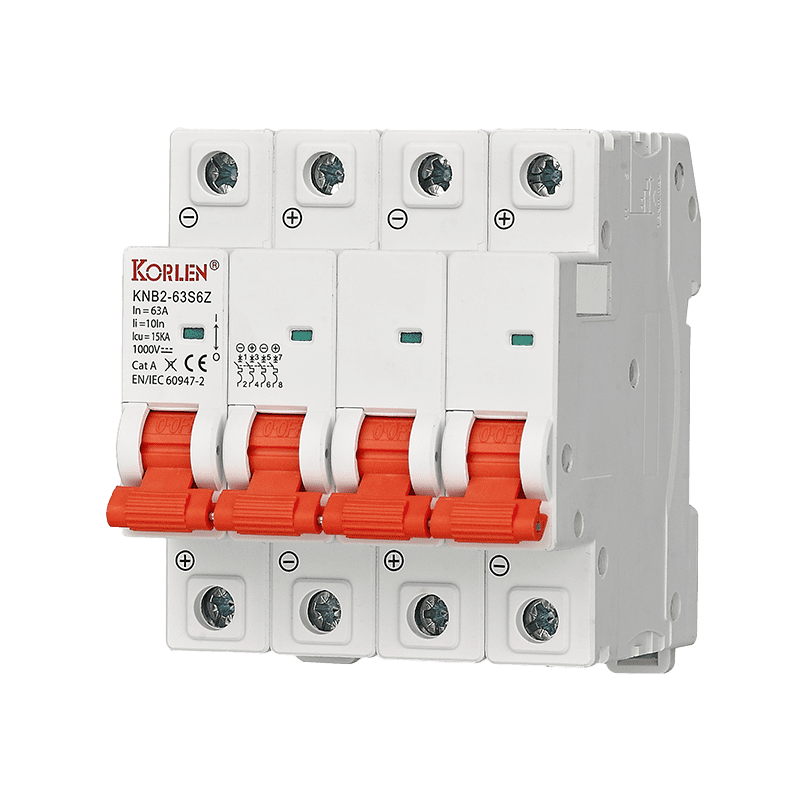
Korlen KNB2-63S6Z — 15 kA DC MCB for high-performance storage
| Model | DC rating | Link |
|---|---|---|
| KNB2-63DC | 6 kA DC | View |
| KNB2-63S6Z | 15 kA DC | View |
Only if it is validated for the BESS fault level and, where your topology reverses, for bidirectional interruption. Korlen DC MCBs are suited to DC battery-side protection — confirm the rating with your pack’s max voltage and fault current. See the 15 kA model.
Because strings can back-feed or parallel at unequal voltages, driving large equalizing currents. The DC breaker must still clear a fault regardless of direction.
Size by maximum OC voltage and stack 250 V DC poles in series: a 48 V Li-ion stack (≈60 V max) often uses 2 poles; a 400 V DC bus needs 2–4 poles in series.
No. Without DC arc quenching it can weld or sustain an arc. Always use a DC-rated MCB with blow-out and polarity marking.
The DC Icn must exceed the prospective battery fault current, which is high due to low cell impedance. Korlen offers 6 kA and 15 kA DC ratings; pick per your short-circuit study.
BESS protection is PV protection plus a bidirectional twist. Specify DC breakers by maximum pack voltage, DC breaking capacity, and validated reverse-current interruption — and never substitute an AC MCB on a battery bus.
Korlen supports BESS and PV integrators with DC MCB selection, pole-stacking, and certification documentation.
© Korlen Electric. For B2B specification reference. Validate all DC ratings against your battery short-circuit study and applicable energy-storage standards.
GAONENGGELE ELECTRICAL SHARES CO.,LTD.
Privacy Policy | SiteMap
Copyright GAONENGGELE ELECTRICAL SHARES CO.,LTD.