- Whatsapp: +86 15967777035
- Email: [email protected]

In the past, protecting an electrical system required two separate devices: one for overloads and one for leakage. Today, the residual current operated circuit breaker with overcurrent protection—commonly known as the RCBO breaker—has revolutionized distribution board design.
While residual circuit current breakers (RCCBs) protect humans from life-threatening shocks, the RCBO circuit breaker goes a step further by protecting the entire circuit from every major electrical fault.
| Korlen RCCB | Korlen RCBO |
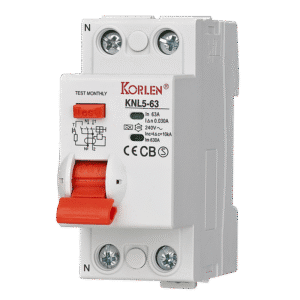 |
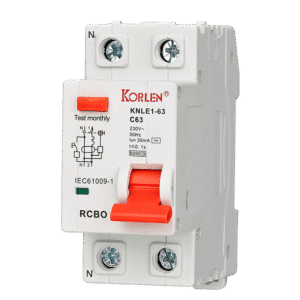 |
Comparison between Korlen RCCB and RCBO circuit breaker for space-saving distribution.
An RCBO (Residual Current Breaker with Overcurrent) is a “2-in-1” device. It combines the functions of an MCB (overload and short circuit protection) and an RCCB (earth leakage protection).
Space Saving: Because it is a single unit, an RCBO breaker saves significant rail space in the distribution board.
Independent Protection: If one circuit has a leakage fault, only that specific breaker RCBO will trip, leaving the rest of the building in power.
When selecting a device, you must identify the RCBO type symbols on the front casing, as they directly define its application range and compatibility with your load equipment. Choosing the wrong type can lead to nuisance tripping, incomplete protection, or even safety hazards.
Designed only for sinusoidal alternating current, Type AC RCBOs are suitable for purely resistive loads such as heaters, incandescent lamps, boilers, and basic power sockets without electronic drivers. They are the most economical choice for traditional residential and general-purpose wiring.
Type A RCBOs protect circuits with pulsating direct current components, making them ideal for modern equipment like LED lighting, switching power supplies, TVs, computers, household appliances, and small variable-frequency devices. They have become the mainstream choice for contemporary commercial and residential installations.
Type B RCBOs handle smooth DC leakage currents and are specially engineered for electric vehicle (EV) chargers, solar inverters, industrial drives, medical equipment, and high-power frequency converters. This type is essential in industrial applications and new energy systems to ensure stable coordination with MCCB molded case circuit breakers and avoid unwanted shutdowns.
Properly wiring a RCBO is critical for both safety and functionality. If the neutral is crossed or improperly seated, the device will experience nuisance tripping.
To ensure a safe installation, follow these professional steps on how do you wire a rcbo:
| Installation Step | Detailed Operation | Key Notes & Safety Tips |
| Mounting | Clip the RCBO onto the DIN rail in the distribution board. | Lock it firmly and align with MCBs or MCCBs for easy maintenance. |
| Line Connection | Connect the incoming Live wire to the RCBO’s ‘L’ or ‘1’ terminal. | Tighten the terminal to avoid overheating from loose contact. |
| Load Connection | Connect outgoing Live and Neutral wires to the RCBO’s load terminals. | Ensure correct polarity to prevent device malfunctions. |
| Neutral Flylead | Connect the RCBO’s neutral flylead to the consumer unit’s neutral bar. | Do not skip this step—it ensures accurate leakage detection. |
| Testing | Press the ‘T’ button to test if the RCBO trips normally. | Recheck wiring if it fails to trip before use. |
Mounting
Start by securely clipping the RCBO circuit breaker onto the standard DIN rail inside the distribution board, making sure it is firmly locked in place and properly aligned with other protective devices such as MCBs and MCCBs.
Line Connection
Connect the incoming mains “Live” conductor from the distribution busbar or main incoming switch to the designated input terminal on the RCBO, typically marked with an ‘L’ or the number ‘1’. Ensure the connection is tight to avoid overheating or loose contact.
Load Connection
Wire the outgoing circuit’s “Live” and “Neutral” conductors to the clearly marked load-side terminals on the RCBO. This section supplies protected power to downstream sockets, lighting, or equipment.
Neutral Flylead
Most RCBO units include a dedicated neutral flylead, usually white or blue. This essential internal connection must be linked directly to the neutral bar in the consumer unit to enable correct residual current detection and safe operation.
Testing
Once you connect RCBO units completely, always press the clearly marked ‘T’ (Test) button to simulate a leakage fault and verify that the device trips reliably. This final check confirms proper installation and functional protection.
For global distributors, the choice between a standalone residual circuit current breaker and an RCBO depends on project complexity and budget.
Reliability: Korlen’s RCBO range is tested for thousands of duty cycles, ensuring that the “Overcurrent” and “Residual Current” mechanisms never interfere with one another.
Compliance: Every residual current operated circuit breaker we manufacture meets IEC/EN 61009-1 standards, making them suitable for high-spec commercial and residential tenders.
Q1: How to wire RCBO in a multi-phase system? In three-phase systems, you should use a 4-pole RCBO, ensuring that all phases and the neutral are routed through the device to maintain the magnetic balance.
Q2: Can I use an RCBO as a main switch? No, a RCBO breaker is a branch circuit protection device. A main switch is required for total isolation of the board.
Q3: What causes an RCBO to trip immediately after wiring? This is often due to a “Neutral-to-Earth” fault or a crossed neutral. Ensure the neutral for that specific circuit is connected to the RCBO, not the common neutral bar.
As building codes become more stringent, the RCBO is becoming the default choice for modern installations. Whether you need a high-sensitivity residual current operated circuit breaker for a hospital or a robust breaker RCBO for an industrial plant, Korlen provides the engineering excellence you can trust.
Ready to upgrade your inventory? Explore Korlen’s Premium RCBO and RCCB Solutions and get a quote for your next project today!
GAONENGGELE ELECTRICAL SHARES CO.,LTD.
Privacy Policy | SiteMap
Copyright GAONENGGELE ELECTRICAL SHARES CO.,LTD.