- Whatsapp: +86 15967777035
- Email: [email protected]

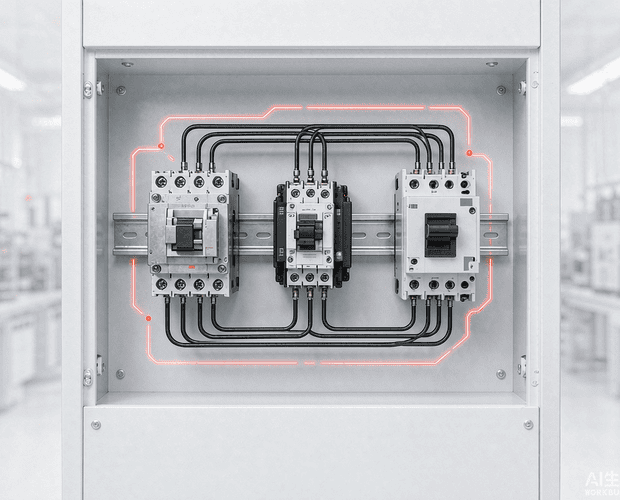
Quick summary. A motor is not “protected” by one device. A code-compliant branch needs four functions — disconnect, short-circuit protection, switching, and overload protection — and the contactor, thermal overload relay and manual motor starter are the pieces that deliver them. This guide shows how to combine them into a working circuit, with verified data from Korlen’s KNC1, KNR8, KNS12 and KNHC ranges.
Most motor failures are not dramatic. They start as a slow overload, a single-phasing fault, or a contactor that was never matched to the load — and by the time the winding burns, the protection was already there on paper but miscombined. The fix is not a bigger breaker; it is putting the right three devices in the right order. Below, we build a motor protection circuit from its components and size each one with real Korlen data.
Whether you buy a sealed manual motor starter or assemble from parts, a compliant motor branch needs four functions (in power-flow order):
An MMS crams all four into one box. A contactor + thermal overload relay delivers functions 3 and 4, and you add 1 and 2 with a disconnect and an MCB/MCCB. The protective outcome is identical — the difference is packaging, cost and serviceability.
A contactor is an electrically operated switch. It carries no protective function on its own; its job is to make and break the motor circuit under control-signal command — pushbutton, sensor, or PLC. Korlen’s KNC1 AC contactor covers 9–95A at up to 660V (AC-3), and the KNC8 series extends to 400A at 690–1000V. Both accept a thermal relay plugged directly in, turning a bare switch into a starter.
The overload relay is the only device here whose sole job is thermal protection. It ignores harmless starting inrush but trips on slow overload, and a 3-pole version also catches single-phasing. Korlen’s KNR8 thermal overload relay spans 0.1–400A (up to 800A frames), tripping class 10A, rated −25℃ to +55℃, and mounts directly onto a matching contactor.
An MMS (manual motor starter) combines overload + short-circuit + manual disconnect + switching in a single, locally controlled unit. Korlen’s KNS12 manual motor starter covers 0.1–80A at AC 690V with a thermo-magnetic trip and an adjustable dial, and can double as an isolation point.
The elegant part is the wiring logic, not extra parts. The overload relay has a normally-closed (NC) auxiliary contact wired into the contactor coil circuit. On overload, the relay opens that NC contact, which de-energizes the contactor coil, which opens the power contacts and stops the motor. So the relay never switches fault current itself — it simply tells the contactor to do it. That is why a thermal relay always rides behind a contactor for control and behind an MCB/MCCB for short-circuit clearing.
In a building-automation panel where the load is lighting, heating, ventilation or a small pump rather than a motor, a KNHC modular contactor (400V, up to 100A, IEC/EN 61095) is the right switching piece — low-noise, DIN-rail, and purpose-built for AC-7a/7b loads.

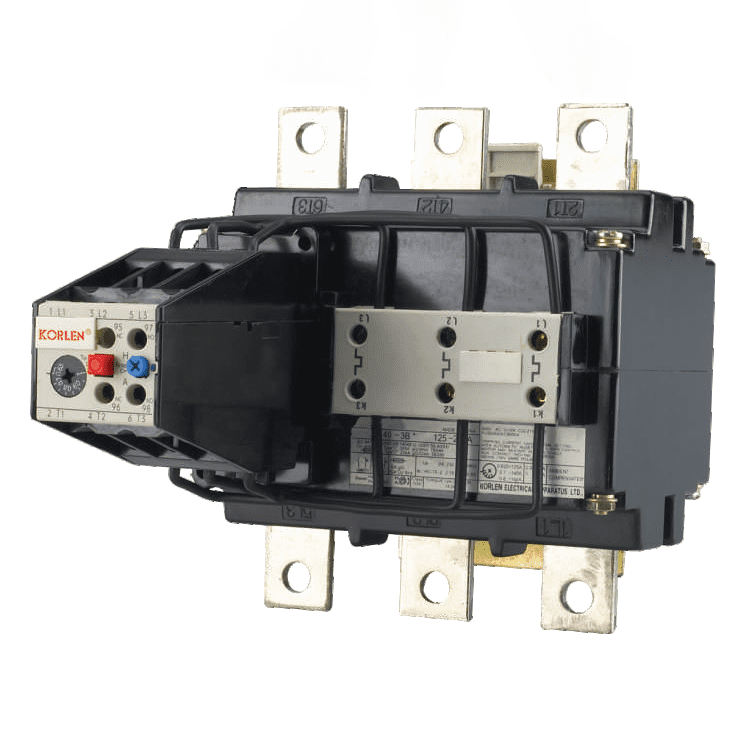
Korlen supplies every piece of the chain, so a panel can be built from one source. Verified ratings:
| Device | Range | Key spec | Standard |
|---|---|---|---|
| KNC1 AC contactor | 9–95A | up to 660V, AC-3 | IEC 60947-4-1 / GB14048.4 |
| KNC8 AC contactor | 9–400A | 690–1000V, AC-3 | IEC 60947 / VDE 0660 |
| KNR8 thermal overload relay | 0.1–400A | Class 10A, −25~+55℃ | IEC 947-4 / VDE 0660 |
| KNS12 manual motor starter | 0.1–80A | AC 690V, thermo-magnetic | IEC 60947.1/2/4.1 |
| KNHC modular contactor | up to 100A | 400V, AC-7a/7b | IEC/EN 61095 |

This is a packaging choice, not a protection-level choice — both satisfy the same intent. Our longer MMS vs thermal overload relay comparison goes deeper, but the short rule:
Common mistakes:
One-page checklist:
Can a contactor protect a motor by itself?
No. A contactor only switches; it has no thermal or short-circuit sensing. It must sit behind a short-circuit device and work with an overload relay (or be an MMS that contains one).
Why does the overload relay trip the contactor, not the motor directly?
The relay’s NC contact is wired into the contactor coil circuit. On overload it de-energizes the coil, so the contactor’s power contacts open the load. The relay never interrupts fault current itself — safer and longer-lasting.
Is an MMS enough, or do I still need an MCCB?
The MMS already provides overload + short-circuit + isolation + manual switching for its own branch. For panel-level coordination and higher fault duties you still add an upstream MCCB/MCB. For a single small motor fed from a protected board, the MMS alone is often sufficient.
Need a motor protection circuit configured?
Korlen is a low-voltage electrical manufacturer supplying AC contactors, thermal overload relays, manual motor starters and modular contactors with IEC/EN compliance.
GAONENGGELE ELECTRICAL SHARES CO.,LTD.
Privacy Policy | SiteMap
Copyright GAONENGGELE ELECTRICAL SHARES CO.,LTD.