- Whatsapp: +86 15967777035
- Email: [email protected]

Quick summary. A reliable PV protection scheme comes down to three devices working together — a DC MCB for overcurrent, a Type 2 SPD for surge/lightning, and an isolator switch for safe maintenance. This guide walks through how to select and combine them, with verified ratings from Korlen’s actual product range.
A rooftop or ground-mounted solar PV array is only as reliable as the protection behind it. DC circuits from PV strings behave differently from AC mains — they do not cross zero naturally, so arc faults and surge events are harder to clear. Getting the protection right is what keeps the inverter alive and keeps service crews safe.
Solar installations face three recurring risks that the protection scheme must address:
The three device types below map directly onto these three risks.
A DC miniature circuit breaker sits between each string (or pair of strings) and the inverter to clear faults that an AC-side breaker cannot handle. Korlen’s KNB2-63DC 6kA DC MCB is built for PV strings, and the KNB2-63S6Z variant extends breaking capacity to 15kA for larger commercial arrays.
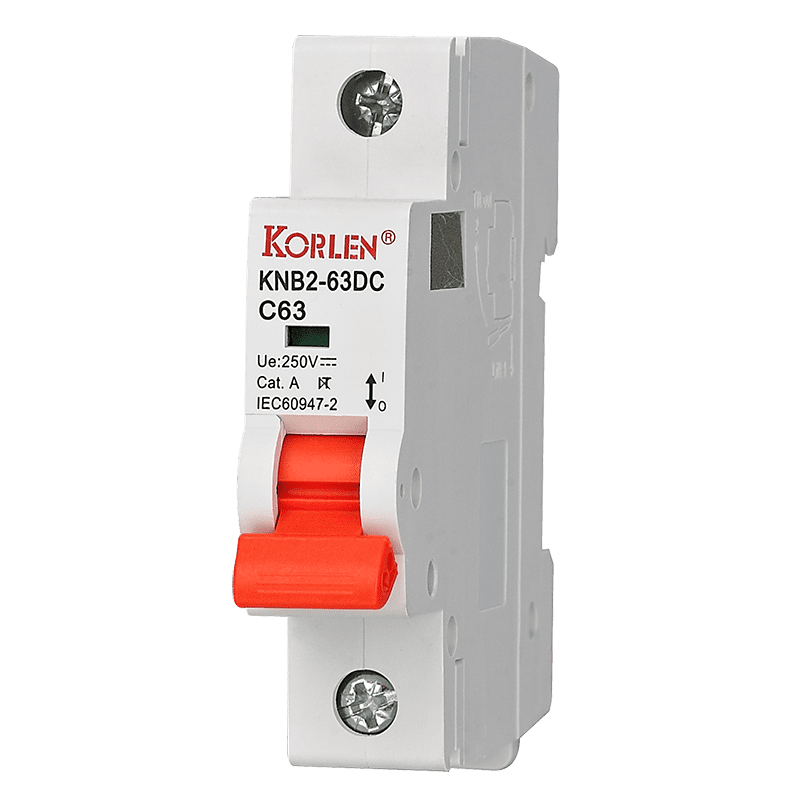
When sizing the DC MCB:
A Type 2 surge protective device is installed at the inverter AC feed (and often at the distribution board) to clamp overvoltage from lightning and grid events. Korlen’s KNY-40 Type 2 SPD is a T2 AC surge protector with the following verified ratings:
| Parameter | KNY-40 (per voltage variant) |
|---|---|
| Max continuous operating voltage Uc | 275V / 320V / 385V |
| Nominal discharge current In (T2) | 20kA |
| Maximum discharge current Imax | 40kA |
| Protection level Up (L-N) | 1.5kV / 1.5kV / 1.8kV |
| Protection level Up (N-PE) | 1.2kV |
| Response time tA | 25ns |
| Recommended disconnector | LT-SSD40 |
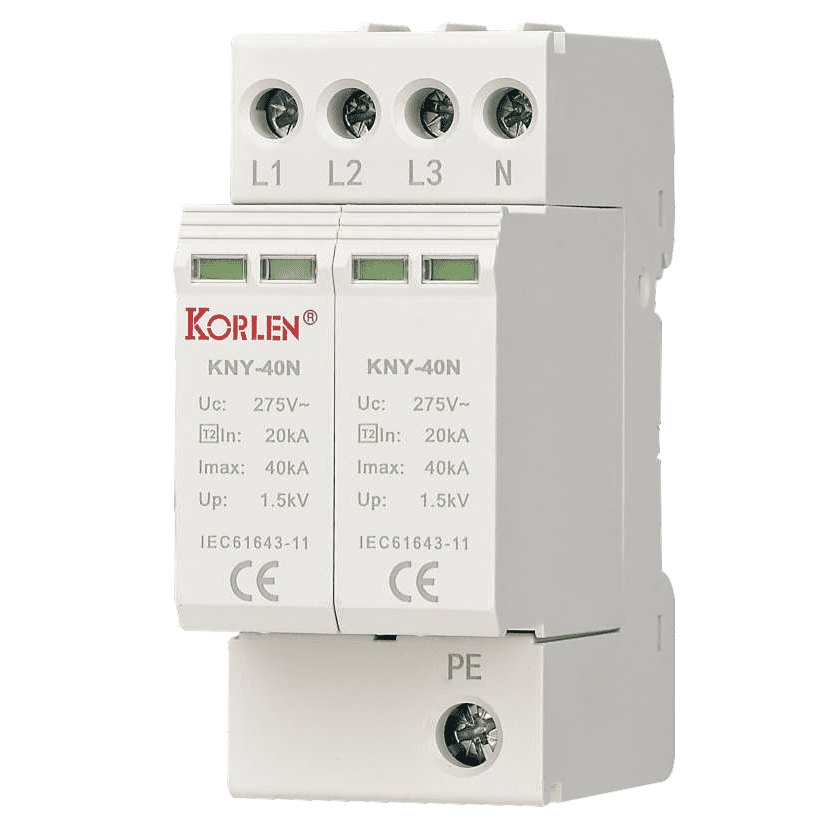
Select Uc above the system’s highest continuous voltage, and pair the SPD with its dedicated disconnector so a failed module fails safe instead of taking the circuit down.
Because PV modules generate whenever exposed to light, a clearly marked disconnect is mandatory before anyone touches the array. A DIN-rail KNH2-100 isolator switch (and the silver-contact KNH1-100) gives a visible break point on the DC side. Place one at the array combiner and another at the inverter so either end can be isolated.
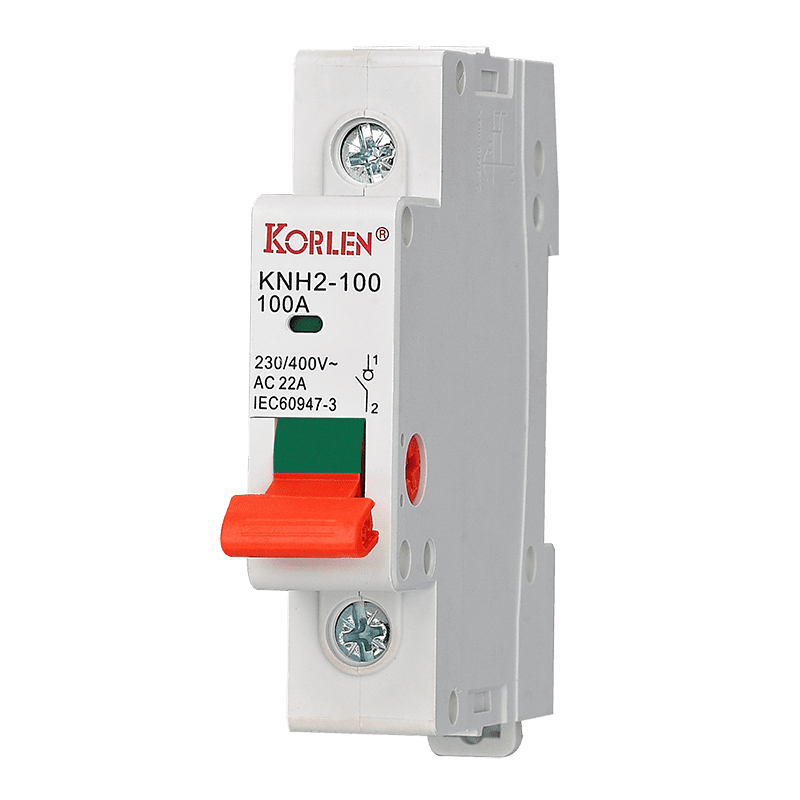
For a typical single-phase residential array, a working bill of materials looks like this:
Can I use a normal AC MCB on the DC side?
Not recommended. DC arcs do not self-extinguish at the AC zero-crossing, so a DC-rated MCB such as the KNB2-63DC is required for reliable breaking.
Where does the SPD go?
At the AC distribution board feeding the inverter (Type 2), and optionally at the DC combiner for exposed sites. The KNY-40 covers the Type 2 AC position.
Do I still need an isolator if I have a DC MCB?
Yes — an MCB is a protective trip, not a maintenance disconnect. A KNH2-100 isolator provides the visible break point required for safe work.
Need a protection scheme sized for your array?
Korlen is a low-voltage electrical manufacturer supplying DC MCBs, Type 2 SPDs and isolator switches with IEC/EN compliance.
GAONENGGELE ELECTRICAL SHARES CO.,LTD.
Privacy Policy | SiteMap
Copyright GAONENGGELE ELECTRICAL SHARES CO.,LTD.