- Whatsapp: +86 15967777035
- Email: [email protected]

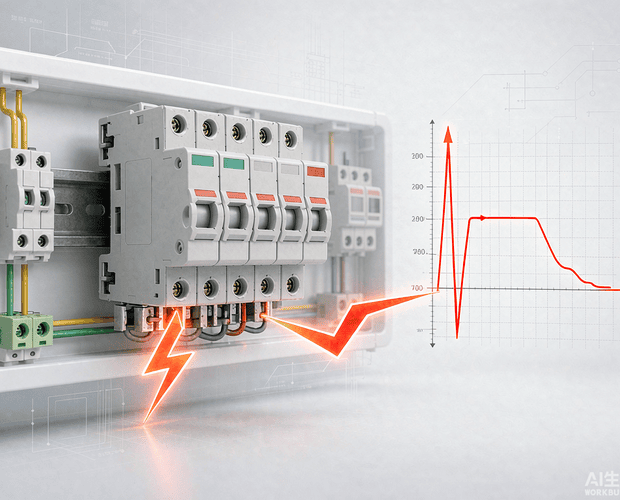
Quick summary. A Type 2 SPD is the workhorse surge protector for every distribution board. Its job is to clamp lightning- and grid-induced overvoltage to a level your equipment can survive. The four numbers that decide whether it fits — Uc, In, Imax and Up — are easy to read once you know what each one protects against. This guide explains them with verified data from Korlen’s KNY-40 range.
📑 Table of Contents
Surge protective devices are small, cheap, and almost always the difference between a near-miss and a destroyed inverter, PLC or server rack. Yet most selection mistakes come down to misreading four rated values on the label. This guide walks through each one, shows how they interact, and uses Korlen’s KNY-40 Type 2 SPD as a worked example with real data.
IEC 61643-11 defines three SPD classes by where they sit in the surge-protective chain:
A Type 2 SPD is therefore the standard board-mounted protector. In a typical install you put one at the main incoming board and another at sub-boards feeding exposed or sensitive loads. Our PV protection guide shows the same device sitting at the AC feed of a solar inverter.
Read the label in this order — each value answers a different question.
Uc is the highest AC (or DC) voltage the SPD can carry forever without degrading. Rule of thumb: pick Uc at least 10–20% above the system’s highest continuous voltage. For a 230/400V TN network, a 275V variant is marginal; 320V or 385V is the safer choice for grids with chronic overvoltage. Undersizing Uc is the single most common cause of premature SPD failure.
In is the current the SPD can absorb repeatedly (the “every-storm” rating). A higher In means longer service life. For most commercial and light-industrial sites, 20kA is a solid baseline; exposed or high-lightning-risk sites justify 20kA or more.
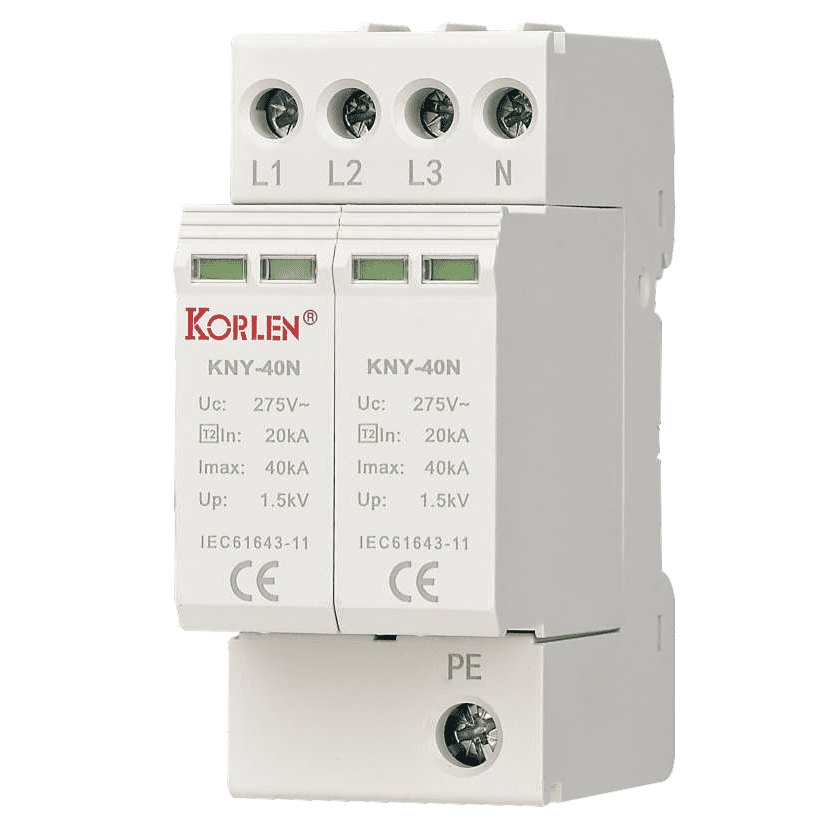
Imax is the single largest surge the SPD can survive once (the “worst day” rating). It is always ≥ In. The gap between In and Imax tells you the margin for an extreme event. Korlen’s KNY-40 rates Imax at 40kA, double its 20kA In.
Up is the residual clamping voltage the SPD lets through during a surge. This must stay below the impulse-withstand voltage of the equipment you are protecting (a typical protected device tolerates 1.5–2.5kV). Up is what actually saves your load, so it is the number to check against your gear — not just the current ratings.
Two more values matter in practice: tA (response time, the faster the better — KNY-40 is 25ns) and the short-circuit withstand / backup rating (the SPD must be backed by a device that clears a follow current if the varistor short-circuits).
Korlen’s KNY-40 Type 2 SPD is offered in three Uc variants so the same module fits 275V, 320V and 385V networks. The verified ratings:
| Parameter | KNY-40 (per voltage variant) |
|---|---|
| Max continuous operating voltage Uc | 275V / 320V / 385V |
| Rated voltage Un | 220V |
| Nominal discharge current In (8/20µs, T2) | 20kA |
| Maximum discharge current Imax | 40kA |
| Protection level Up (L-N) | 1.5kV / 1.5kV / 1.8kV |
| Protection level Up (N-PE) | 1.2kV |
| Response time tA | 25ns |
| Recommended disconnector | LT-SSD40 |
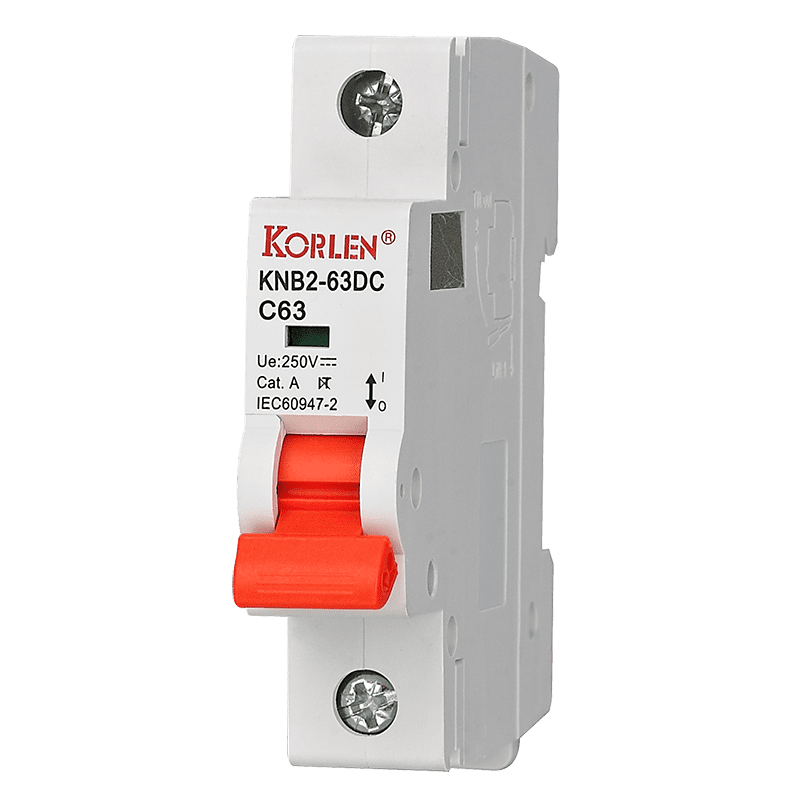
Solar sites need surge protection on both sides of the inverter. The AC side takes grid and induced surges (Type 2, as above). The DC side — long PV cabling acting as an antenna — needs a DC-rated SPD and DC-rated overcurrent protection. Korlen’s KNB2-63DC DC MCB provides the DC-side overcurrent break; pair it with a DC SPD at the combiner for exposed arrays.
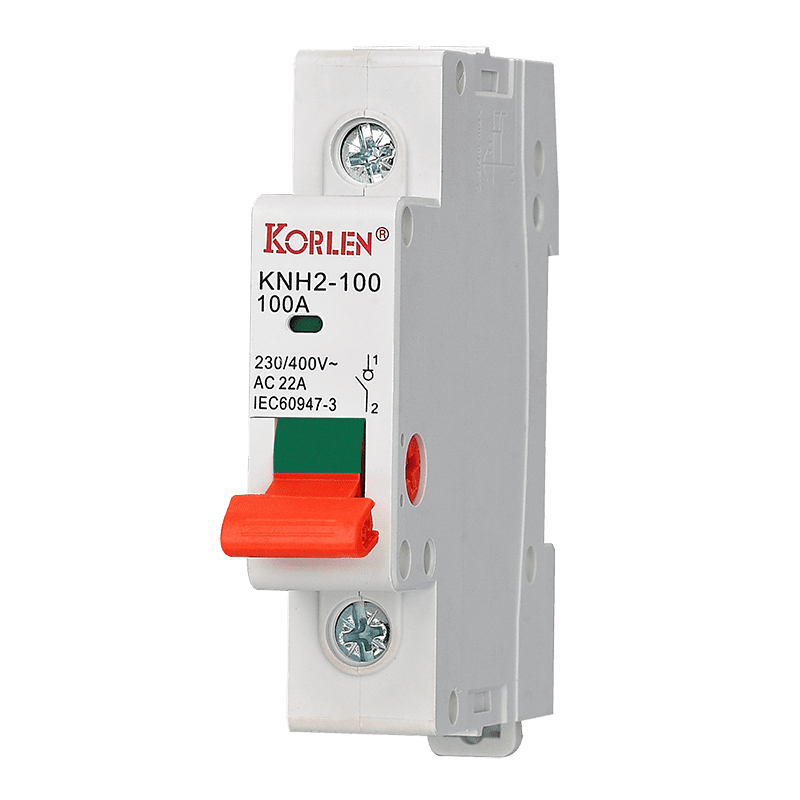
An SPD is not a standalone device. If its varistor fails short, a follow current must be cleared safely. Two things are required:
Common mistakes:
One-page checklist:
Do I need a Type 2 if I already have a Type 1?
Yes. A Type 1 handles the direct strike at the service entrance; the Type 2 downstream absorbs the residual and the induced surges on internal wiring. They are complementary, not interchangeable.
Can one SPD protect both AC and DC?
No — AC and DC SPDs are rated differently (DC has no zero-crossing, so arc clearing is harder). Use an AC-rated Type 2 at the inverter output and a DC-rated SPD at the PV combiner.
How do I know it has failed?
KNY-40 modules have a visible status window; pair them with the LT-SSD40 disconnector so a failed module isolates instead of faulting the circuit. Inspect at least annually, or after a major nearby strike.
Need a Type 2 SPD sized for your board?
Korlen is a low-voltage electrical manufacturer supplying Type 2 SPDs, DC MCBs and isolator switches with IEC/EN compliance.
GAONENGGELE ELECTRICAL SHARES CO.,LTD.
Privacy Policy | SiteMap
Copyright GAONENGGELE ELECTRICAL SHARES CO.,LTD.